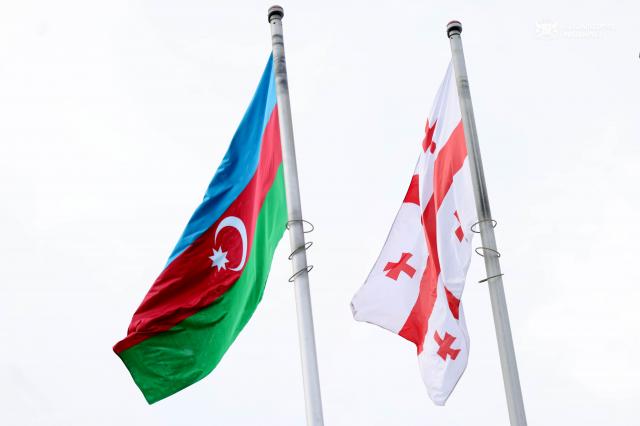
Azerbaijani Media Accuse Georgia of Border Delays, Tariff Pressure
Azerbaijani government-aligned media outlets have accused Georgia of deliberately obstructing Azerbaijani trucks at the border, as well as imposing high railway transit tariffs on Azerbaijani fuel destined for Armenia, insinuating emerging tensions between Baku and Tbilisi amid the announced Trump Route.
Georgian authorities dismissed the truck-related accusations as “disinformation,” while, in apparent response to tariff-related reports, Georgian Dream Prime Minister Irakli Kobakhidze ordered on December 5 the Georgian Railway to “immediately” carry out a one-time, free shipment of Azerbaijani fuel to Armenia.
The exchanges come against the backdrop of the announced Trump Route for International Peace and Prosperity (TRIPP), a transit link that would connect mainland Azerbaijan with its Nakhchivan Autonomous Republic through southern Armenia and, via that route, provide access to Armenia and Turkey while bypassing Georgia.
While some regional leaders argue that TRIPP could also create new opportunities for Georgia, observers have worried it could undermine Tbilisi’s widely promoted role as a Middle Corridor linking East with the West. Azerbaijani media reports cited “jealousy” of Tbilisi – worried about the loss of regional logistical “monopoly” – as a potential motive for alleged obstruction.
Alleged Truck Delays
The reports started emerging in Azerbaijani media in late November. Citing truck drivers, two Baku government-aligned outlets, Caliber and Minval Politika, reported on November 29 that the border delays specifically targeted Azerbaijani trucks, were systemic, and went beyond what they described as “bureaucratic complications.”
“Drivers were being stopped without clear reasons, document processing times stretched into weeks,” Caliber wrote in an article titled “Georgia senses the Zangezur Corridor’s rise.” According to the outlet, “attempts to seek explanations were met with irritation, evasive responses, and circumstances in which decisions depended not on regulations but on the mood of individual Georgian customs officers.”
“Drivers also reported cases where they were ‘hinted’ at the possibility of speeding up the process – effectively being asked for informal payments – which further exposed the true nature of what was happening,” the outlet added.
The outlet further said, citing truck drivers, that they encountered “rudeness” from customs officers and that the processing of required documentation was “deliberately delayed,” citing two cases in which drivers were held at a Tbilisi customs office for three weeks.
Minval Politika described a similar situation, saying the delays particularly affected trucks carrying tobacco and tobacco products, and that such cases have been occurring since September.
“This is not simply about certain ‘bureaucratic difficulties’ that sometimes occur at customs when moving cargo,” the outlet said, adding, “Georgian customs officers and road police are singling out Azerbaijani trucks, while long-haul drivers from other countries and from Georgia itself pass through customs checkpoints quickly and without problems.”
Outlets Point at Transit Jealousy, Russian Interests
Both reports cited similar explanations for the alleged situation.
First, the two outlets said several truck drivers were told by border officials to “go through Zangezur,” apparently referring to the announced Trump Route, which will bypass Georgia. “Against the backdrop of Georgia’s decades-long monopoly in regional logistics, even the possibility of an alternative route is perceived in Tbilisi as a painful development,” Caliber said.
“Paradoxically, the Zangezur route could strengthen the economies of all countries in the region, including Georgia itself,” the article added, stressing, “It expands the network – it does not replace it.”
“But such logic does not work at every level, and where calculations should prevail, emotional jealousy sometimes takes over.”
Another article also argued that while “Tbilisi now understands it faces a real risk of losing its [logistics] monopoly,” Georgian authorities “should be making it as easy as possible for Azerbaijani freight carriers to pass through their customs points, making Georgia a more attractive logistics corridor in the face of competition,” noting that the current situation suggests otherwise.
- 25/09/2025 – Kavelashvili Talks ‘Multipolar’ Order, ‘Ultimatums’, Peace, and Middle Corridor at UNGA
- 18/11/2025 – Jonathan Askonas, State Department Representative, Visits Georgia
Second, both articles pointed to what they described as the presence of Armenia-linked figures within Georgia’s governance. “They are present in the system visibly enough for their attitude toward Azerbaijan to manifest itself in sensitive areas such as this one,” Caliber wrote. “But we still hope that Georgia is a governable state capable of understanding and pursuing its own interests,” Minval Politika added.
The Caliber article additionally referred to what it described as discussions in “analytical articles” about Georgia’s evolving ties with its “northern neighbor,” Russia, saying that “irritation was caused by the very fact that the agreements on the Zangezur Corridor were reached in Washington, and that the project is moving forward without the involvement of those who have long considered such processes their sphere of control.”
It added, “against this backdrop, it is suggested that certain groups oriented toward the interests of that northern country may have used any convenient pretext to create conditions that complicate the movement of Azerbaijani drivers through Georgia.”
Both articles concluded by emphasizing Azerbaijan’s interest in protecting its citizens wherever they are, while criticizing Georgia over the alleged situation.
Tariff-Related Allegations
On December 5, Minval Politika published another article titled “Georgia Is Playing Against the World: Tbilisi Is Testing the Limits of Baku’s Patience.”
The outlet referred to a November 28 meeting of the Armenia-Azerbaijan joint commissions on border delimitation, saying one issue discussed was the export of Azerbaijani oil and petroleum products to Armenia. It said that because there is no direct rail link between the two countries, Georgia remains the only transit route.
Citing an unnamed source, the outlet added that Azerbaijan had requested tariff terms from Tbilisi for the Gardabani-Sadakhlo section and claimed that the Georgian side proposed a tariff it described as “40 times” higher than comparable rates for similar cargo.
“Such behavior inevitably raises eyebrows,” the media outlet wrote. “The country [Georgia] in whose economy Baku has consistently invested and supported for decades cannot afford the luxury of ignoring Azerbaijan’s interests. Responsibility is a key criterion for the maturity of states, and Georgia is currently undergoing a test of this maturity,” it warned.
Tbilisi Responses
Georgian Dream Prime Minister Irakli Kobakhidze dismissed reports of alleged mass delays involving Azerbaijani truck drivers in comments to journalists on December 2. “As far as I know, there was a delay in only one case, and for a specific reason,” he said.
Georgia’s Revenue Service also rejected the allegations, which were also circulated by Georgian media based on Azerbaijani reports, as “yet another disinformation,” calling them a “lie” intended to “mislead society.” The agency cited what it said was “increased cargo turnover” at the border and said it was taking all necessary steps to ensure the swift processing of vehicles. It also said Georgia is obliged to prevent the evasion of international sanctions against Russia and Belarus.
On December 5, amid critical reports about the tariffs and what the Economy Ministry said were “requests from partner countries,” GD PM Irakli Kobakhidze ordered Georgian Railways to allow “immediate” one-time transit of Azerbaijani fuel to Armenia free of charge. The Economy Ministry said Georgia “is and remains a strategic and reliable partner of Armenia and Azerbaijan,” adding that it has consistently supported regional peace and cooperation.
Roman Gotsiridze, a former president of Georgia’s National Bank and former opposition United National Movement lawmaker, said what he called the Azerbaijani media “campaign” is meant to “make a fuss and pressure Georgia,” rejecting claims that the Georgian Dream government was deliberately antagonizing its neighbors. He said the dispute should be viewed through the prism of competing national interests rather than a single policy misstep.
Gotsiridze warned that Georgia’s position has weakened amid growing international isolation, arguing that the loss of key partners undermines its ability to defend its interests, including in relations with neighbors. He pointed to Georgia’s continued reliance on Azerbaijani gas, with a preferential supply contract via the Baku–Tbilisi–Erzurum pipeline set to expire in 2026, as a source of vulnerability, amid broader European demand for Azerbaijani gas. “They [Azerbaijan] are making us feel that the trump cards are in their hands – above all, our dependence on Azerbaijani gas.”
“When a government is internationally isolated, it cannot adequately defend the country’s interests,” Gotsiridze said, in reference to the Georgian Dream.
Also Read: