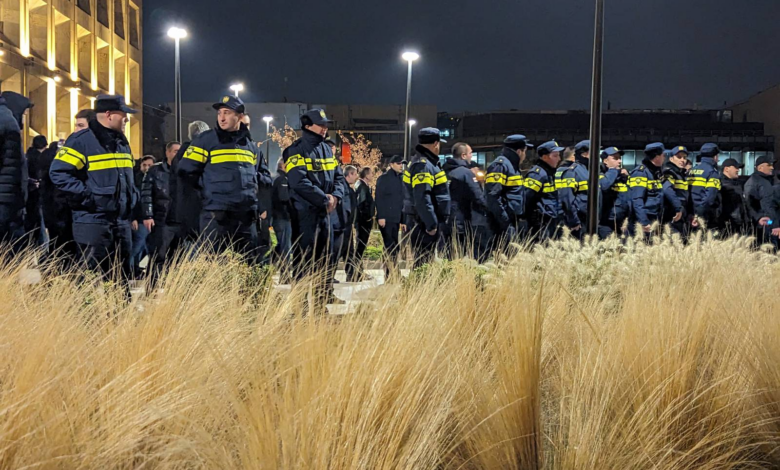
Georgian Dream Plans to Extend Anti-Protest Laws to Pedestrian Zones
The ruling Georgian Dream plans to extend anti-protest laws to pedestrian zones, introducing mandatory notice for such rallies and allowing administrative detention – and, for repeated acts, criminal sentences -for taking part in demonstrations that obstruct “uninterrupted movement of people,” among others.
The initiative, unveiled on December 8 by Irakli Kirtskhalia, Georgian Dream’s parliamentary majority leader, follows an intensifying crackdown on daily rallies in Tbilisi, including the introduction of detentions and eventual criminal liability for “blocking roads” and “covering faces” during protests in October. Under the new bill, such restrictions would now also apply to demonstrations taking place in pedestrian areas.
“These changes are being adopted to maximally protect a balance both regarding the freedom of assembly and expression, as well as to maximally protect the rights of citizens who live their daily lives in this country,” Kirtskhalia said during a briefing. In an obvious reference to daily Tbilisi rallies, he pointed at “payrolled group of three hundred people” who “try to create maximum discomfort for our citizens.”
Current protest regulations require prior notification, with at least five days’ notice in case of a non-spontaneous rally, to the municipal authorities only if the protest activity is expected to obstruct traffic.
Under the new bill, organizers of the rally “held in areas of movement of people or transport or obstructs the movement of transport, people” would be required to notify the Interior Ministry instead of municipal authorities – five days in advance for non-spontaneous rallies and “immediately, within a reasonable time” for spontaneous rallies.
The Ministry, in turn, would be mandated to propose an alternative location or route if the planned location and route “threaten public order, the normal functioning of state and public bodies, enterprises, facilities and organizations, or transport, as well as the uninterrupted movement of people or human rights and freedoms.” The bill also prohibits “artificially blocking traffic or pedestrian routes” unless the size of the demonstration necessitates it, and allows police to declare a rally illegal if participants refuse to clear the road – including pedestrian passages – within 15 minutes of a police warning.
If protesters refuse to comply with the prior notice rule or “artificially” block the pedestrian road, they could face administrative detention of up to 15 days, while organizers could face up to 20 days. Repeat offenses would incur criminal liability, punishable by imprisonment of up to one year.
In response to the non-stop demonstrations that erupted last November following Georgian Dream’s announcement to halt EU integration, the ruling party has repeatedly tightened protest laws. This included the introduction of heavy fines for protest-related offenses late last year, as well as October amendments imposing administrative detention and eventual criminal sentences for those “blocking roads” or “covering faces” during demonstrations, measures that human rights groups condemned as effectively criminalizing peaceful protest.
For nearly a year, protesters have daily blocked Tbilisi’s Rustaveli Avenue in front of parliament as a symbolic act of resistance. In the initial weeks of enforcing the new laws since October, over a hundred people were arrested, many of whom were sent to administrative detention, while one was charged criminally for a “repeated act.”
Starting in early November, police physically pushed protesters onto the sidewalks to prevent road blockages, prompting demonstrators to switch to evening downtown marches as an alternative form of protest. Detentions, however, continued during these marches.
Also Read:
This post is also available in: ქართული