Monday Cable – December 8, 2025
Good morning, dear reader. As we return from a week marked by the unfolding Watercannongate controversy and ongoing debates over education reform, culminating in rallies by conservative, far-right groups in Tbilisi against what they call “Arab cities”, it appears these three controversies will keep Georgian Dream on the defensive for some time.
Watercannongate
Last week began with the BBC’s bombshell investigation suggesting that Georgian police may have mixed the “WWI-era” toxic chemical camite into water cannons used against protesters last November and December. Georgian Dream authorities immediately came under fire, and responded by dismissing the BBC as a “deep state” ally, seizing on the Trump controversy, and threatening legal action against the broadcaster. Under pressure from journalists, officials admitted that some substance had indeed been mixed into the water, but denied it was camite and withheld disclosure of the chemical, instead calling for patience until the “investigation” concluded. The probe, led by the State Security Service of Georgia, looked into both potential abuse of power and “assistance to a foreign organization in hostile activities.”
On December 6, less than a week after opening the investigation, the State Security Service of Georgia (SSSG) announced that it had concluded one part of the probe and identified the substance used in water cannons on the night of December 4–5 as chlorobenzylidene malononitrile. This chemical agent is known as CS, the most common tear gas when used in gaseous form. Purchased between 2007 and 2009, and it was apparently used with a solvent, propylene glycol, as a liquid. The agency did not disclose what was used on other nights of dispersal. While acknowledging that the Interior Ministry also had trichloroethylene – another highly toxic solvent – in storage, the SSSG claimed these supplies had been “written off.” The service said it continues to investigate possible “foreign assistance” and dismissed the BBC report as “complete and deliberate disinformation” intended to “damage Georgia’s interests.”
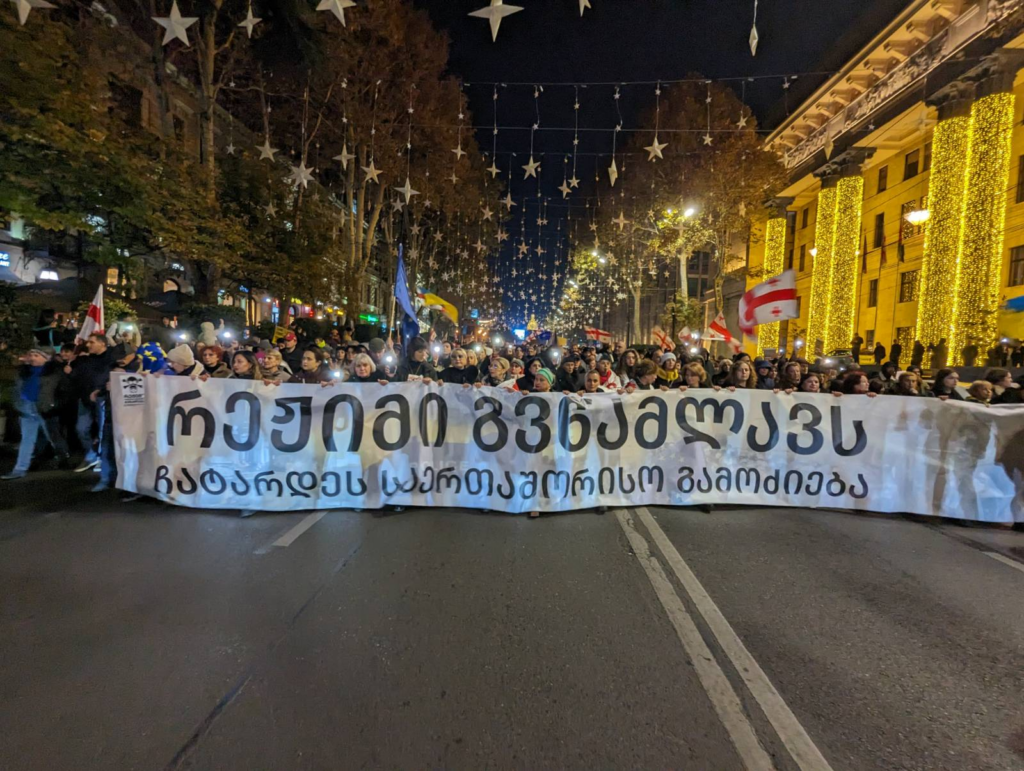
Questions continue to linger, as few trust the authorities: five days seems too short to investigate the matter, yet too long for the Interior Ministry to disclose what was used. Large crowds marched late on December 6, demanding an independent international investigation. Whatever the truth, the controversy has been among the most intense to hit the ruling party in recent months, and a rare occasion when GD has been on the defensive for a week in the information space it usually dominates.
Academia Bracing
Also on December 1, the government approved the controversial higher education concept unveiled by Irakli Kobakhidze in mid-October. While essentially unchanged from the initial version, authorities appear to have made minor adjustments, at least to cosmetically address opponents’ concerns about compatibility with the Bologna Process: critics had feared the proposed reform would compromise students’ ability to pursue studies abroad. Remaining concerns persist: the government maintains plans for radical restructuring, including the “one city, one faculty” model, under which a single faculty – such as law or social sciences – can only be offered at one state university per city.
While Georgian Dream touts the abolition of the state grants system – another proposed change that makes studying at state universities tuition-free for those who get in – as a step toward boosting access to education, critics argue that the reform may ultimately result in fewer admissions and reduced availability of higher education.
Authorities have yet to provide details on how the reform will affect student numbers per program or university, saying that labor-market research is still underway and that they will decide based on the results. State universities, which currently account for 19 of Georgia’s 64 accredited higher education institutions, will also be barred from admitting international students (save a couple of exceptions). Overall, critics warn that the radical reforms could have “catastrophic” consequences, potentially setting the country’s education system back decades, and anticipate heavy repression and purges of professors not aligned with the ruling party. We will be writing more on the subject.
In the same package: on December 2, Georgian Dream Education Minister Givi Mikanadze also unveiled general education system reform concept that, among other initiatives, would introduce state-approved single textbooks across all public schools, make uniforms mandatory for grades 1–6, ban mobile phones during class hours, and restructure the system around an 11-year schooling model, with the 12th grade becoming optional.
Other News:
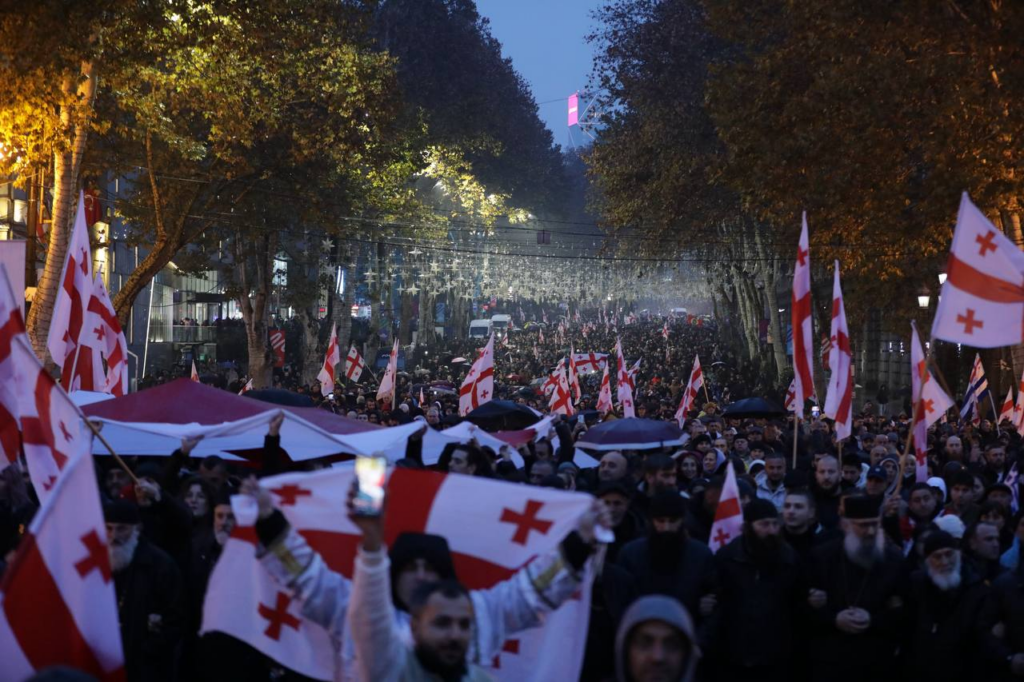
Eagle Hills Drama: While Georgian Dream’s more liberal, pro-Western critics focused mainly on the BBC report and relatively forgot about the controversial Emirati investment, far-right opponents of the ruling party latched onto it, mobilizing crowds to protest what they called two “Arab cities” near Tbilisi and Batumi. Turnout was significant, with crowds led by the far-right Alt-Info and Conservatives for Georgia parties filling the area in front of parliament on December 7, blocking Rustaveli Avenue, and later marching to Holy Trinity Cathedral. The real estate megaproject, promoted by GD as the most significant investment in Georgia’s history, has drawn criticism on multiple fronts: concerns about commercial secrecy, economic, social, and environmental impact, as well as opposition from previously friendly far-right groups worried about what they call Georgia’s “Arabization.” More about the controversy here.
Expulsions Continue: In an apparent attempt to accommodate anti-migration sentiment, Georgian Dream authorities have doubled down on deportations. The Interior Ministry reported 28 new expulsions-related detentions on December 5, while Irakli Kobakhidze previously boasted that 1,131 illegal migrants were expelled in 2025, equaling the total deportations of the past seven years, and indicated that the government aims to expel “at least 3,500” more in 2026.
What to expect
American Uncertainties: The Georgian opposition didn’t hear much good news from the U.S. this week. First came The Hill’s report that U.S. Senate Majority Leader John Thune blocked the advance of the MEGOBARI Act, which foresees sanctions on Georgian officials, by turning down a request from House Speaker Mike Johnson in November to include it in the annual must-pass National Defense Authorization Act (NDAA) bill. Having passed the House vote in May, MEGOBARI stalled in the Senate due to reported opposition from some senators. Attaching the act to the NDAA was seen as one of the easier paths for its proponents to advance the bill, and – while not yet officially pronounced dead – the reports of the blockage have made its fate even more uncertain.
Another piece of bad news came with Trump’s new National Security Strategy, which some in Georgia fear may have devastating consequences for small countries like Georgia. “American war minister confirmed that the unipolar world has ended,” Tornike Sharashenidze, international politics pundit, wrote, calling to “remember the concepts mentioning which used to be considered a crime. These are: national interests; balance of power.” Historian Beka Kobakhidze wrote: “This, too, will pass, but before it passes, the Russian neighborhood and Europe may suffer irreparable damage.”
From Our Archives:
OTD in 2014, Civil.ge reported: “German Foreign Minister Frank-Walter Steinmeier hailed close bilateral ties with Tbilisi, reiterated Germany’s support to Georgia’s European integration, saying that the country is closer to visa-free regime with the EU, and also expressed Berlin’s support to Georgia’s NATO integration, noting that Germany was behind substantial package of cooperation, which was offered to the country at the alliance’s summit in Wales.” Read the full report here, and read how things have changed since in our key takeaways of the German Ambassador’s November interview with RFE/RL Georgian service.
Visual Politics
Tbilisi’s Rustaveli Avenue was busy this weekend. On December 6, protesters marched to demand accountability and an international investigation over the alleged use of toxic substances on protesters last year. On December 7, conservative crowds gathered to rally against the Emirati Eagle Hills investment. Eagle Hills’s Tbilisi office has operated in the former Rustaveli Cinema building, right across the parliament. Decent turnout in both rallies.