State Security Service: Georgian Police Used CS Gas, Not Camite, on Protesters
The State Security Service of Georgia (SSSG) said that the substance that police have used against protesters over the years, including on December 4-5 last year, was chlorobenzylidene melanonitrile, also known as CS gas, and that authorities have never purchased camite as suggested by the BBC’s recent investigation.
O-chlorobenzylidene malononitrile, aka CS gas, is a compound most commonly used by law enforcement agencies as a tear-gas agent in crowd-control operations. The SSSG did not specify whether the substance was mixed with water-cannon streams, as implied in the BBC report, but said it was used with a solvent.
“The chemical powder that the Georgian Ministry of Internal Affairs has purchased and which has been used over the years, according to necessity during ongoing rallies, is chlorobenzylidene melanonitrile,” Deputy SSSG Head Lasha Maghradze said during the briefing, noting that the agency had completed the portion of the investigation into the BBC report focused on identifying the substance in question.
“In the initial days of December 2024, specifically on the night of December 4-5, the substance used for crowd control was chlorobenzylidene melanonitrile, while a substance used as a solvent was propylene glycol,” the official noted, without specifying whether the same or other substances were used on other nights of dispersals.
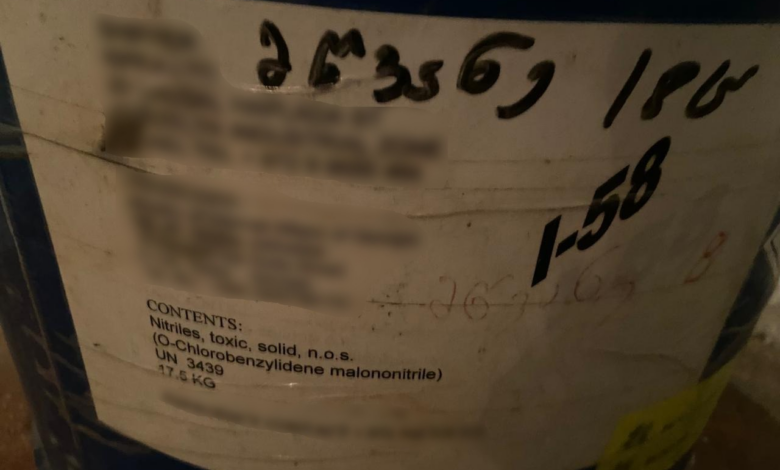
During the briefing, the agency aired the images of alleged substances, showing barrels labeled with the substance name and a transportation code.
According to Maghradze, chlorobenzylidene melanonitrile was purchased from an ‘Israeli company’ on December 17, 2007, and during its transportation with the solvent trichloroethylene in 2009, it was assigned the international transportation code UN3439, while the solvent was given UN1710, matching the codes identified in the BBC report as “two unnamed chemicals” in the 2019 copy of the Special Tasks Department inventory.
The official added that over the past 20 years, various Georgian organizations have imported civilian, industrial, and medical goods of dozens of different types under the same transportation codes a total of 606 times. He also specified that in the case of trichloroethylene, authorities had seized “880 liters of written-off remains” of the substance from the MIA’s Special Tasks Department, the unit responsible for riot control.
As for the bromobenzyl cyanide, also known as camite, the “WWI-era” substance suggested by the BBC investigation, Maghradze said the Georgian Interior Ministry “has never purchased such a substance.”
The use of camite on humans “causes the gravest and often even lethal consequences,” he said, noting that Health Ministry records show that of the 54 people hospitalized by emergency services in the days following November 28, 2024, only five exhibited “mild intoxication,” and all were discharged the following day.
Georgian security services opened an investigation into both possible abuse of office and “assistance to a foreign organization in hostile activities” on December 1, hours after a BBC report went public.
The SSSG said it questioned 93 witnesses, including doctors, protesters, and NGO representatives mentioned in the report, as well as former and current MIA officials and other experts. The agency added that it had seized 25 samples for analysis at the public Levan Samkharauli Forensic Bureau.
According to Maghradze, the only witness the agency was unable to question was Lasha Shergelashvili, identified by the BBC as the “former head of weaponry” at the Special Tasks department, who had suggested that police may have used the same compound he was asked to test in 2009.
The deputy SSSG head said Shergelashvili, who he said is currently in Ukraine, is wanted in a separate criminal case, referring to an October 5 report when authorities said they found an arms cache near Tbilisi, linking it with the October 4 unrests and a “military unit” in Ukraine.
“The investigation is working on a version, according to which Lasha Shergalashvili, contracted by Ukrainian special services, ordered Beka Chulukhadze days before October 4 to purchase the above-mentioned combat material, explosive substances, and devices and hide them near Tbilisi,” Maghradze alleged. While Chulukhadze’s name has previously been mentioned in the investigation, this is the first time Shergelashvili has been named in connection with the case.
Calling the BBC report “complete and deliberate disinformation” serving to “damage Georgia’s interests,” Maghradze said the SSSG continues the investigation in the part of “assisting a foreign organization in hostile activities.”
Citing chemical weapons experts, whistleblowers from Georgia’s riot police, and medical professionals, a BBC Eye investigation published on December 1 suggested that a WW1 military-grade agent known as camite may have been mixed in water cannons and used during the first days of pro-EU demonstrations in Georgia that began on November 28, 2024.
The findings came amid longstanding concerns from Georgian protesters, human rights groups, and medical professionals about the use of toxic substances during rallies, with many reporting long-term health complications. The report intensified both local and international scrutiny of Georgian Dream authorities, who threatened legal action against the British broadcaster. Georgian opposition parties and international watchdogs, including Amnesty International, have called for an independent international investigation into the matter.
Under media pressure, Georgian officials admitted to mixing a substance into water cannons but denied that it was camite.
Also Read:
This post is also available in: ქართული