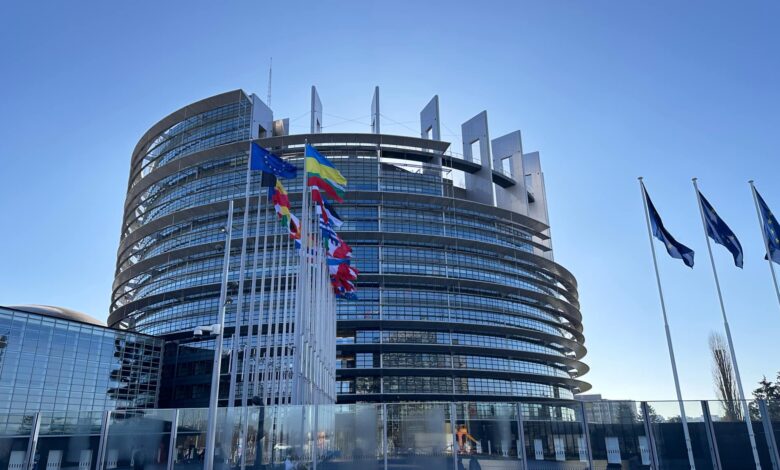
European Parliament Holds Debate on Georgia’s “Deepening Democratic Crisis”
Members of the European Parliament debated the situation in Georgia on December 17, with the agenda item titled “the deepening democratic crisis in Georgia.”
While most MEPs expressed concern over the Georgian Dream government’s course, citing alleged abuses against protesters, democratic backsliding, the deterioration of the rule of law, and a stalled EU accession process, a smaller number defended the ruling party.
The debate comes amid a busy week in Brussels and Strasbourg, including an EU Council meeting on December 16, the scheduled EU summit on December 18–19, and the eighth visa suspension report expected later in the week.
Addressing the Parliament, Danish Minister for European Affairs and President-in-Office of the EU Council Marie Bjerre said that the EU has repeatedly expressed “grave concern” over democratic backsliding in Georgia.
“Our concerns are the deteriorating rule of law, politically motivated detentions, pressure on independent media, and the conduct of the 2025 municipal elections. We are also concerned about deliberate disinformation and anti-Union narratives spread by the Georgian authorities,” she said.
Danish Minister referred to the GD delegation’s refusal to participate in the 12th Ordinary Session of the Euronest Parliamentary Assembly in Yerevan, noting that “this year also saw Georgia drifting away from regional cooperation amongst parliaments, at a time when dialogue is most needed.”
She said discussions in the Council confirmed that Georgian authorities’ actions “fall short of the EU’s expectations of a candidate country,” adding that Georgia has been “clearly backsliding across the nine steps” under which candidate status was granted.
“As a result, Georgia’s EU accession process has effectively come to a standstill, and this will be the case until Georgian authorities demonstrate the firm commitment to reverse course and return to the EU accession path,” she said.
Danish Minister explained that this requires “freeing all arbitrarily detained politicians, journalists and activists, repealing representative legislation, adopting democratic, comprehensive and sustainable reforms in line with the core principles of European integration, and stopping the aggressive narrative against the EU.”
She concluded by paying tribute to “the thousands of Georgians, students, journalists, activists and ordinary citizens” who have been peacefully protesting for over a year, saying their courage is “a reminder that European values are alive in Georgia.”
Michael McGrath, European Commissioner for Democracy, Justice, the Rule of Law and Consumer Protection, said Georgia under the GD government is “drifting away from democratic norms,” and described the scale of the political and human rights crisis as “unseen in an enlargement country.”
Referring to the EU enlargement report released on November 4, McGrath said it provided a “clear assessment” of democratic regression and “unprecedented” anti-EU rhetoric by a candidate country.
“Rapid erosion of the rule of law, adoption of restrictive legislation, instrumentalization of the judiciary and a closing of civic space – all fall short of EU expectations from a candidate country,” he said, adding that the authorities “have done everything they can to deprive the Georgian citizens of a European future.”
“I urge the Georgian authorities to see the enlargement report as an opportunity to reflect, to change their course, to rebuild trust, and to return to the EU path, for Georgia’s future ultimately rests in their hands.”
The Commissioner said this year, the EU mobilized an additional EUR 24 million to support civil society organizations and independent media in Georgia.
“Despite the increasingly repressive context, we will continue to assist pro‑democracy civil society, human rights defenders, independent media and citizens across the country, and we will make sure that Georgian citizens are informed about the EU’s continued support,” he concluded.
Lithuanian MEP Rasa Juknevičienė of the European People’s Party (EPP) group addressed the recent BBC investigation, which suggested that Georgian police may have used a World War I–era toxic compound against protesters in 2024, and called for an independent international investigation.
“I call on the [European] Commission and Council to react, to initiate an international independent investigation. The fact that the Georgian authorities are afraid of an independent investigation only shows that they are afraid of the truth and punishment,” Juknevičienė This shows that the facts revealed by the BBC are most likely true. We must help the struggling Georgian people, because Georgia is Europe,” she stressed.
German MEP Tobias Cremer of the Group of the Progressive Alliance of Socialists and Democrats (S&D) also called for an international investigation, saying that “we must say it clearly that if these reports are true and this regime uses chemical weapons against its own population, then they have given up all pretence and all ambitions to join this European family.”
“Let us finally impose real and targeted sanctions, not just on a few diplomatic passports, but on the de facto ruler Ivanishvili himself, and on every single one of his accomplices involved in such heinous crimes,” Cremer outlined.
French MEP Thierry Mariani of Patriots for Europe Group expressed a different view over Georgia, arguing that the country is under “unprecedented media pressure from European institutions.”
“These attacks call into question the legitimacy of the institutions in Tbilisi, its judicial system, and the sovereign choices of Georgian voters. This is interference by foreign NGOs and political networks, with the European Parliament acting as their mouthpiece and zealous advocate,” he claimed.
Addressing the Commissioner McGrath’s remark over allocating financial support for Georgian civil society, he asserted: “It is true that, here, you dream of overthrowing a Georgian government that does not obey the injunctions of the European Commission. Indeed, this country is guilty of wanting to protect its constitutional order and to fight against all attempts at destabilization, whether they come from Moscow or from Europe.”
In contrast to Mariani, MEP Adam Bielan of the European Conservatives and Reformist Group (ECR) said the ruling party had turned away from European and NATO integration and increased vulnerability to external influence, particularly from Russia.
“Let me be clear: our solidarity is with the Georgian people and with Georgia’s vibrant civil society, which for years has been the engine bringing the country closer to the Euro‑Atlantic community,” he said.
Bielan reiterated the demand for “the unconditional release of former President Mikheil Saakashvili on humanitarian grounds, so that he can access adequate medical treatment abroad.” He concluded that “Georgia still has a European choice, but that choice is made through free citizens, free institutions, and free debate.”
Renew Europe’s MEP, Malik Azmani, said Georgia is being pushed toward “a Russian-style autocracy,” citing restrictive laws, violence against protesters, and alleged use of chemical agents.
“The EU has waited too long and must impose targeted sanctions now: suspend visa liberalisation for Georgian Dream officials – they must pay the price, not the Georgian citizens.”
Azmani added that the “EU must apply real pressure: demand the release of all political prisoners immediately and insist on new, free and fair elections. No excuses, no delays. We owe it to all those fighting for a free and democratic Georgia.”
Austrian MEP Lena Schilling of the Greens/European Free Alliance group recalled her visit to Georgia and attendance at a court hearing of imprisoned journalist Mzia Amaghlobeli, saying that “When I stand before you today, I do so for Mzia,” and all the people in the country “who are not being heard.”
“The EU has a responsibility to these courageous people to be just as courageous, to impose sanctions, and to enforce them, sanctions that really hurt, that hurt those who deserve it, those who oppress people,” she said.
In contrast to the majority of the MEPs, non-attached Czech MEP Ondřej Dostál argued that Georgia is a sovereign state, “not some sort of EU colony.”
“We do not have to admit them [Georgia] into the EU – it was not very likely anyway. But we need them as partners, and we should engage with Georgia in respectful and mutually beneficial relations, while Georgians are still willing to engage with us.”
Another non-attached MEP, German Lukas Sieper, emphasized the need for the EU’s “real support” for Georgian civil society and closer cooperation through parliamentary platforms such as Euronest.
“Let’s strengthen our cooperation with them, let’s build on their participation in the Euronest Parliamentary Assembly. We need to act swiftly. We need to act strategically. We need to act bravely, as Georgian people are fighting for their freedom while there is still time,” he said.
Also Read:
- 07/10/2025 – EU Parliament Backs Easier Suspension of Visa-Free Travel Amid Concerns Over Georgia
- 19/07/2025 – EU Parliament: No EU Membership for Georgia until Changing Authoritarian Course