Dispatch – December 14: Village Club
“Village club” is a bad word. The phrase is often used to describe a low-taste, uncivilized, noisy gathering. Village club can be anything – it can be a parliament session with silly arguments and even sillier flattery; it can be some pseudointellectual discussion; or a debate where everyone talks over each other; or simply an unfortunate assembly of people you don’t like. But when I first heard the term used in a negative context, I didn’t quite understand. We had a club in our village, and it was a decent club. What was wrong with villagers occasionally gathering for a good evening rave?
Here is Nini and the Dispatch newsletter, to tell about village clubs, and why it matters whether they are a bad word or a good word.
I don’t exactly remember which summer it was when the club opened, but it was soon after the Rose Revolution. Saakashvili had just been elected, he was still in his charismatic reformer phase, and his antics had yet to turn the public against him. Enthusiastic officials were being appointed in municipalities, so our small, green village in Western Georgia, too, began to acquire a new life. A computer center was launched in a tiny room in a grey cube of a local government building, where local kids could sit at their Pentiums, type their names into all kinds of WORDART shapes, and browse the websites of their favorite football clubs.
Then the peak vacation season approached. Kids with Tbilisi accents started arriving from the capital, and the anticipation of new friendships mixed with the inevitable city-versus-countryside tension. Things came alive, and to make things more exciting, local authorities came up with the idea of starting a “discotheque.” They chose the spacious room in the same government – or “Council” – building, the very room that had hosted movie screenings decades ago. The space was dark enough for parties, had a stage, and a smaller room for a bar.
The two-storey building itself stood on an open plateau, close to the highway and some hundred meters from the neighborhood’s birzha – a place where villagers of all ages and genders would gather for evening talks (not to be confused with present-day city birzhas, where a bunch of unfulfilled men distract themselves from their misery by opining about geopolitics).
When the parties kicked off, locals didn’t need much of an invitation. Soon, the club became the talk of the municipality.
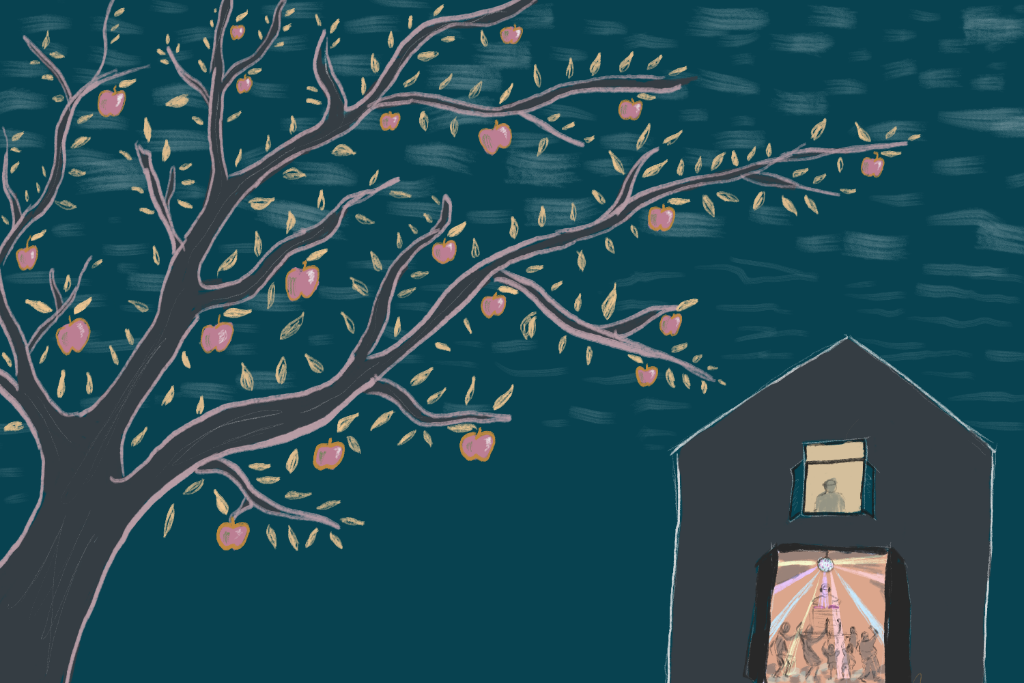
The music was loud. The dark room was lit by the disco ball and filled with people. Locals mingled with those coming from afar for the rumored events, and the DJs were brought in from the town. There was room for everybody: young, flirty villagers brought their drama; town people brought their style and arrogance; older ones brought drinks and fistfights here, while we, the kids, brought our curiosity. No dress code, no judgment, and, of course, no age restrictions: not only were children allowed on the dance floor, but we also had no trouble purchasing booze – officially a whisky, really God only knows – for a small allowance at the bar.
If you were hungry, there was a tree in an orchard across the street. It had some good apples – not ripe enough to harvest but ripe enough to steal.
One-Season Wonder
It’s unclear why the parties didn’t last more than one season.
One would think it was due to an inevitable conservative reaction, but we weren’t doing that anymore, and we weren’t doing it yet. Georgia was still going through this post-Soviet phase in which freedom of religion was embraced alongside many other freedoms. Families started going to church, but the same families would later gather for the evening Latin telenovela home screenings, and no one was shown out of the room, even when the scenes cut to hot, bleach-haired Colombian farmers doing adult things in their barns.
Another explanation could be that the post-Revolution honeymoon phase had ended, and once-enthusiastic party officials were increasingly distracted by infighting, dismissals, and arrests. The most likely reason, however, was simpler: no one truly believed the countryside deserved that much fun. Going to discotheques may have felt like the most natural thing in our village, but it turned out to be the exception rather than the rule. The only larger cultural memory it could be traced to was the long-forgotten life of Soviet-era village clubs, the very source of the phrase that would later become derogatory.
Village clubs were widespread in Soviet years. They were gathering places for the local community, hosting concerts, plays, dance clubs, and film screenings. Indian movies were particularly popular, as eyewitnesses testify. Some – like in our village – were situated inside the local council buildings. The fancier villages had separate, larger buildings, and some of them also housed libraries.
After the Soviet Union collapsed, village clubs became one of many complicated legacies.
Sad Afterlife
Those born later either learned about them through older Soviet-era films that idealized rural life, through stories from nostalgic family members, or through the new meaning the term acquired. It’s hard to trace what specifically inspired the negative use of the terminology. Was it a logical reaction against the forced sense of idyll that Soviet club culture offered, meant to distract from the absence of other liberties under totalitarian rule? Or was it simply our snobbish and unignorable disdain for everything village-related?
Whatever the answer, that indecision also seemed to extend to the physical remains of the village clubs. In some villages, their memory rotted in locked rooms of public buildings. In other places, the larger, separate structures stood abandoned, with local kids still able to sneak inside to explore their glorious ruins. Some of these spaces, while still safe, were inevitably used by locals for funeral dinners or modest wedding parties. Some were auctioned off, some destroyed, and others caught fire, with local reports blaming the “negligence” of a homeless family temporarily sheltered there.
There were occasional reports of locals asking to breathe new life into the buildings. Some apparently succeeded, and the clubs were revived as local cultural centers, most likely with support from international donors who, forever obsessed with community this-and-that, were always ready to fund such endeavours.
Then those donors were pronounced enemies, and village life became nobody’s priority: for the government, rural misery was something to exploit; for the opposition, the same misery was something to occasionally remind the locals about – as if they didn’t feel it themselves – and to explain over and over again how a change of government or EU integration would fix it.
But few ever mentioned that villagers sometimes deserve a little fun, too.
Bad Word, Bad World
Past years have shown that authorities would rather spend millions on social programs to create jobs nobody needs than invest in something meaningful. Leaving rural communities dependent on assistance and remittances has done little to build the social capital vital for keeping local democracy alive. Such neglect is often seen as deliberate evil unleashed by authorities uninterested in democracy. Though sometimes, “evil” is just another word for having nothing to offer.
Neither does repeatedly reducing rural life to mere agricultural work and survival help locals see themselves as part of broader social and political life. Aren’t we all tempted to assume the roles that others stubbornly attach to us?
Anyways, as things stand, Georgian village is doomed to remain a bad place.
At least, as long as it remains a bad word.