Disputed Parliament Tightens Protest Rules, Extends Restrictions to Pedestrian Areas
Georgian Dream MPs in the disputed parliament adopted legislative changes further tightening protest rules, including extending assembly restrictions to pedestrian zones and requiring organizers to submit advance notice of gatherings to the Ministry of Internal Affairs.
The amendments to the Law on Assemblies and Manifestations and the Code of Administrative Offenses, introduced on December 8, were rushed through all three readings and rubber-stamped on December 10.
The changes further tighten protest rules last amended in October, when offenses such as “blocking roads” and “covering faces,” along with other protest-related administrative violations, became punishable by immediate detention rather than fines, while repeat offenses became subject to criminal liability carrying sentences of up to one year in prison.
The current version expands the offense punishable by administrative detention beyond “blocking roads” to also include blocking “areas of movement of people.”
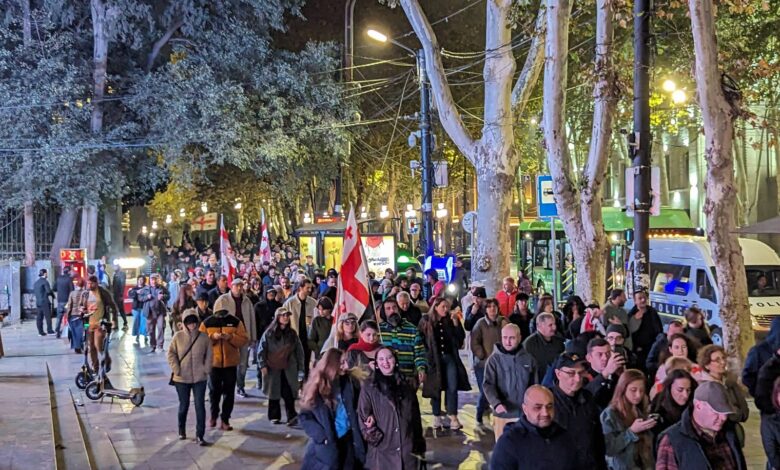
The changes came amid year-long anti-government protests. Starting in November, after the latest amendments, police prevented protesters on Tbilisi’s Rustaveli Avenue, where they had routinely blocked traffic each night, from continuing to block the road, prompting them to switch to evening marches through the city center as an alternative form of protest. Detentions, however, continued during these marches.
“50, 100, or even 150 people should not be allowed to violate the rights of four million people,” the Georgian Dream Prime Minister Irakli Kobakhidze said on December 10 when asked about the purpose of the further tightened rules. “If you do not have sufficient numbers, you should not create problems for the rest of the population…When you are few in number, you must be satisfied with the circumstances you have and respect the interests of the remaining four million people,” he added.
Under the new rules, protests must not impede not only vehicular traffic but also the “movement of people,” effectively extending the offense of blocking roads to pedestrian zones.
“The artificial blocking of vehicle lanes or areas used for the movement of people is prohibited unless required by the number of participants in a gathering or manifestation,” the law reads. “The blocking of vehicle lanes or areas for pedestrian movement using motor vehicles, various structures, and/or objects is also prohibited,” it adds.
Those found to be offenders will face administrative penalties of up to 15 days’ detention for participants and up to 20 days’ detention for organizers.
Under the new rules, organizers of rallies to be held “in areas of movement of people or transport,” or that obstruct their movement, are required to notify the Ministry of Internal Affairs – rather than municipal authorities, as before – no less than five days in advance for non-spontaneous rallies and “immediately within a reasonable time” for spontaneous rallies.
The ministry, in turn, will have three days to review the request and propose an alternative location, time, or route if the planned gathering “poses a real threat to public safety, public order, the normal functioning of enterprises, institutions, and organizations, the unimpeded movement of vehicles and people, or to human rights and freedoms.” Appealing the Interior Ministry’s decision to a court does not suspend enforcement of the order.
Those who fail to comply with the ministry’s orders will be treated as offenders and face detention of up to 15 days for participants and up to 20 days for organizers.
Police will also be allowed to declare a rally “illegal” if participants refuse to clear the road, including pedestrian passages, within 15 minutes of warning. Nona Kurdovanidze, head of the Georgian Young Lawyers’ Association, called the new restrictions unconstitutional, saying limits in places without vehicle traffic are “wholly unacceptable.” She said the sanctions amount to “the criminalization of freedom of expression and assembly” and warned the changes would have “a chilling effect” as a continuation of earlier crackdowns.
In response to the non-stop demonstrations that erupted last November following Georgian Dream’s announcement to halt EU integration, the ruling party has repeatedly tightened protest laws. This included the introduction of heavy fines for protest-related offenses late last year, as well as October amendments imposing administrative detention and eventual criminal sentences for those “blocking roads” or “covering faces” during demonstrations, measures that human rights groups condemned as effectively criminalizing peaceful protest.
For nearly a year, protesters have daily blocked Tbilisi’s Rustaveli Avenue in front of parliament as a symbolic act of resistance. In the initial weeks of enforcing the new laws since October, over a hundred people were arrested, many of whom were sent to administrative detention, while one was charged criminally for a “repeated act.”
Also Read: