Police Intensifies Warnings to Crack Down on Sidewalk Rallies in Tbilisi
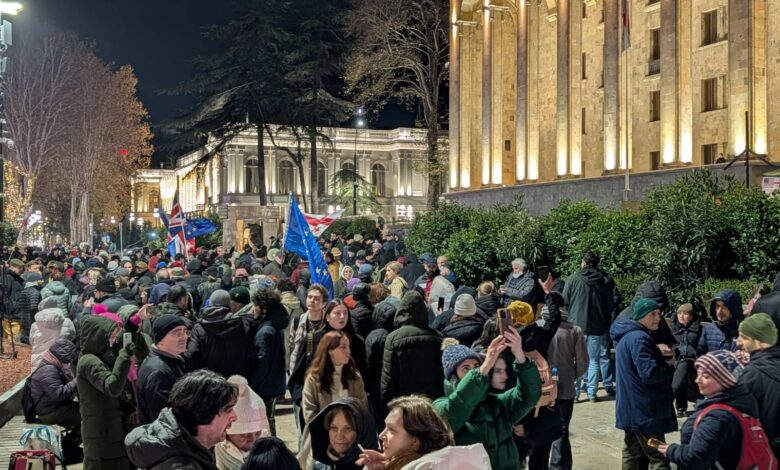
With the holiday season approaching and anti-government protests nearing 400 consecutive days, the Interior Ministry issued binding warnings, instructing demonstrators to confine Rustaveli Avenue rallies in Tbilisi to the parliament stairs and adjacent areas and “not to obstruct traffic” of pedestrians or vehicles.
The warnings follow newly adopted anti-protest laws that extend bans on blocking roads to pedestrian areas and introduce stricter prior-notice requirements. The amendments empower police to issue binding instructions changing the location or route of planned assemblies. Failure to notify police, comply with binding instructions, or clear the road or sidewalks upon police order may result in administrative detention of up to 15–20 days, and criminal liability carrying a sentence of up to one year if repeated.
The new formal warnings, covering rallies scheduled from December 21 through January 9, order participants to avoid threatening “the public safety and order, the normal functioning of agencies, enterprises, institutions, and organizations, the unimpeded movement of transport or people, or other human rights and freedoms.” The ministry also specified the “form of assembly” to be “without a march.”
In recent days, police officials have warned protesters in person and later, on December 17, ordered them to disperse from the sidewalk in front of the parliament, but protesters have ignored the warnings. No detentions have yet been reported specifically for violations of the newest restrictions affecting pedestrian areas.
The ruling Georgian Dream party has tightened protest-related laws multiple times over the past year, including through amendments in October, when acts such as blocking roads and covering faces became punishable by immediate detention rather than fines, with repeat acts subject to criminal liability carrying sentences of up to one year in prison.
For nearly a year, protesters had daily blocked Tbilisi’s Rustaveli Avenue in front of parliament as a symbolic act of resistance. In the initial weeks of enforcing the new laws since October, over a hundred people were arrested, many of whom were sent to administrative detention, while one was charged criminally for a “repeated act.”
Starting in early November, police physically pushed protesters onto the sidewalks to prevent road blockages, prompting demonstrators to switch to evening downtown marches as an alternative form of protest. Detentions, however, continued during these marches.
Protesters and civil society organizations have denounced a new series of anti-protest laws as “unconstitutional,” arguing they effectively criminalize the right to peaceful assembly.
Also Read:
- 20/11/2025 – Police Detain 13 During Solidarity Rally
- 01/11/2025 – Protester Faces Up to One Year in Jail After Police Arrests Him for ‘Repeat Road-Blocking’
- 01/11/2025 – MIA: 29 Detained in Five Days For Blocking Rustaveli Avenue