Kobakhidze Calls on Law Enforcement Agencies, Parliament to Probe High Grocery Prices
Georgian Dream Prime Minister Irakli Kobakhidze called on law enforcement bodies and parliament to probe what he described as excessively high grocery prices, suggesting price hikes may be due to possible cartel-like coordination among retailers, and warning anti-monopoly measures.
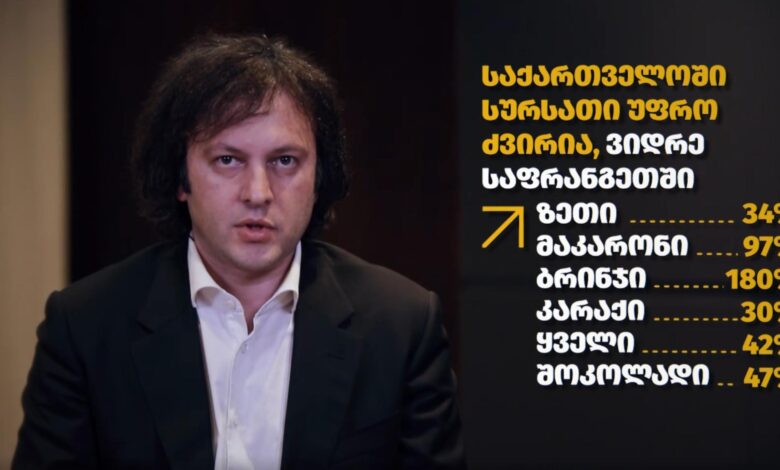
In a three-minute video address, Kobakhidze said comparative analysis revealed stark price differences between Georgian and European supermarkets, with some everyday products costing nearly three times more domestically.
“Comparing prices in chain supermarkets of the same international brand in Georgia and France, the price of a specific brand of sunflower oil in Georgia is 34% higher, pasta 97% higher, rice 180% higher, butter 30% higher, cheese 42% higher, and chocolate 47% higher,” Kobakhidze said.
Kobakhidze attributed these differences to what he called excessive markups averaging 86% from Georgia’s border to store shelves. He said some Georgian retail chains report net profit margins of 7% to 14%, compared to 2% in Europe, despite higher operating costs there. Distributor net profit margins in Georgia, he added, range between 6% and 13.5%.
The financial burden placed on suppliers, he said, is so heavy that “for Georgian producers it is often more profitable not to sell their products in Georgian retail chains, but to export them abroad.”
Kobakhidze also pointed to the rapid expansion of the retail sector, noting that the number of supermarket chains has doubled over the past five years. Georgia now has 113 supermarkets per 100,000 people, compared with 45 in Germany and 62 in Austria.
Among the factors potentially driving higher prices, Kobakhidze listed “the so-called ‘chain cashback,’ an entry fee charged for getting a product into a store, delays in payments to distributors or producers, the abundance of stores, and the reflection of new store opening costs in [product] prices.”
He noted that the current market dynamics raise concerns that market players “may be acting in coordination, on cartel principles, which, naturally, requires additional analysis.” He pledged that the government will actively engage with distributors and retail chains to push prices down.
“If necessary, we will also use anti-monopoly mechanisms that have been tested in various countries,” Kobakhidze said.
He called on law enforcement agencies to “study the issue in depth and determine whether there are signs of a criminal offense in the activities of specific entities. I also want to ask the Parliament of Georgia to establish a parliamentary commission that will use the relevant parliamentary levers to assess the matter.”
The disputed Parliament Speaker Shalva Papuashvili welcomed the initiative, saying that once the spring session opens, they will establish a special commission to “conduct a public examination of food price formation.”
Critics, however, have suspected possible repressive motives behind the initiative.
Roman Gotsiridze, an economist and former president of Georgia’s National Bank, dismissed the initiative as “a crackdown on retail chains,” warning that Kobakhidze’s call on law enforcement to intervene over price increases in supermarkets “represents an expansion of repression into the business sector” and a revival of the Soviet-era system.
“The next step will be the establishment of direct state control over business, as seen in Belarus and similar countries. Soon, the principles of a free market economy will be replaced by the ideology of ‘state capitalism,'” he argued.
Longstanding Concerns
High grocery prices have long remained among key economic concerns for Georgian households. Rising food prices remain a key driver of inflation in the country. Per official data, annual inflation stood at 4.8% in November, fueled largely by a 10.3% increase in food and non-alcoholic beverage prices.
Kobakhidze’s intervention follows earlier attempts by the ruling Georgian Dream party to rein in price pressures. In 2023, under then-Prime Minister Irakli Garibashvili, who now faces corruption charges, the government was ordered to introduce new reforms after a study he commissioned found that some imported food products were sold with markups of up to 100%. At the time, he argued that “one can’t be permitted to get rich at the expense of the people like this, this is wrong behavior.”
Earlier, Georgian authorities had also tried to crack down on high medication prices, including through facilitating drug imports from Turkey, tightening prescription rules by requiring doctors to prescribe medicines by generic names, and introducing reference pricing for more than 5,000 medications.
Also Read:
- 19/12/2025 – Georgia’s GDP Up 6.4% in Q3 2025
- 08/09/2025 – GD Cabinet Meets After Summer Break as Kobakhidze Touts Progress on Economy, Crime
This post is also available in: ქართული