Public Defender to Take Anti-Protest Laws to Constitutional Court
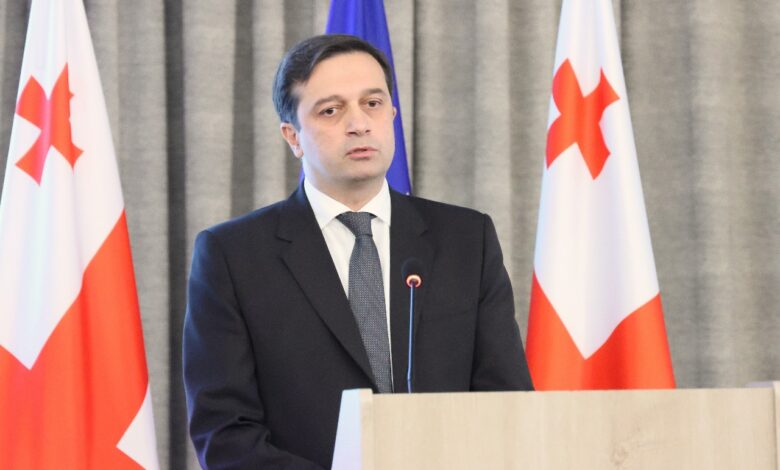
The Public Defender of Georgia, Levan Ioseliani, said his office plans to challenge the amendments adopted by the ruling Georgian Dream party throughout 2025 to crack down on protests in the Constitutional Court, citing, among others, proportionality concerns.
Over the past year, Georgian Dream has rolled out waves of restrictions on freedom of assembly, with initial steep fines for acts such as blocking roads or covering faces during rallies later replaced with detention as a penalty. In December, the measures were expanded to include “obstructing the movement of people” in pedestrian areas, and the ruling party also introduced stricter advance notice requirements.
The remarks of Ioseliani, who has faced criticism over not being vocal enough against Georgian Dream’s repression, come as Georgian authorities begin enforcing the latest amendments. Several protesters have reported receiving court summonses for rallying on sidewalks, but hearings scheduled for December 25 were adjourned, and the courts have yet to issue the first rulings under the new laws.
“What we see is precisely a problem of proportionality and commensurability, using imprisonment without alternative, introducing criminal responsibility [directly] after that,” Ioseliani said during a December 24 interview with the Georgian Public Broadcaster. “We believe that this is the part that should be challenged before the Constitutional Court of Georgia.”
Addressing the advance notice rule, Ioseliani said the concept itself is not new, but warned against transforming it into a de facto rally sanctioning system. The latest amendments require organizers to file advance notice of planned rallies with police and authorize law enforcement to issue binding instructions changing the location, form, or route of protests, with non-compliance punishable by administrative detention and criminal sentence if repeated.
“A provision on [advance] notice exists in the Constitution; this is not new,” Ioseliani explained. “However, it is important that, in its substance, such notice does not turn into something resembling a mandatory sanctioning, which would in itself contradict the Constitution.”
The Public Defender particularly criticised blanket bans on covering faces during rallies, which, per the October amendments, are also punished by administrative detention.
“I think this is a disproportionate sanction in relation to assemblies, and in general, it is illogical how one can prohibit a person from using a face covering,” he said.
Asked whether he agrees with the use of imprisonment for blocking roads, Ioseliani said he does not, arguing that such provisions deprive judges of alternative administrative tools. He also warned that certain laws introduced to crack down on a specific protest, like daily rallies on Tbilisi’s Rustaveli Avenue, will then be extended to other groups as well.
“The fact that certain events are taking place on Rustaveli Avenue, where a particular group, whether for political or other purposes, deliberately and persistently violates the law – if such is the case – cannot be extended to everyone,” he said. He argued that the amedments would mean that they will also apply “in any other place, whether it will be a protest emerged on social grounds or other assemblies, which will incommensurably restrict the freedom of expression of these people, who won’t have a connection to politics.”
Ioseliani also said freedom of expression must be balanced against other rights, particularly regarding the road blockages.
“If we see a sufficient number of people, they have a full and legitimate right to block both pedestrian areas and roadways for transport,” he said. “If such a number is not present, a small group of people does not have such legitimacy. This is consistent not only with international practice, but also with court rulings, and most importantly, with common sense and logic.”
Ioseliani earlier requested OSCE/ODIHR’s opinion over the anti-protest amendments fast-tracked in October, which introduced detention and eventual criminal sentences for blocking the road and covering faces during rallies. The urgent opinion, released in November, called for the repeal of the legislation, warning it raises “serious concerns about Georgia’s lack of compliance with international human rights obligations.”
GD’s Intensifying Crackdown on Protests
For nearly a year, protesters had daily blocked Tbilisi’s Rustaveli Avenue in front of parliament as a symbolic act of resistance. In October, the ruling Georgian Dream party further tightened already strict anti-protest laws, making acts such as blocking roads and covering faces punishable by immediate detention rather than fines, with repeat acts subject to criminal liability carrying sentences of up to one year in prison.
In the initial weeks of enforcing the new laws since October, over a hundred people were arrested, many of whom were sent to administrative detention, while one was charged criminally for a “repeated act.” Starting in early November, police physically pushed protesters onto the sidewalks to prevent road blockages, prompting demonstrators to switch to evening downtown marches as an alternative form of protest. Detentions, however, continued during these marches.
In December, the ruling party expanded restrictions on “obstructing traffic” to include pedestrian areas and introduced a mandatory requirement to notify police in advance of planned assemblies. The amendments authorize police to issue binding instructions altering the location or route of demonstrations.
Failure to notify police, comply with such instructions, or clear roads or sidewalks upon police order may result in administrative detention of up to 15–20 days, while repeat offenses may carry criminal liability punishable by up to one year in prison.
Also Read:
- 24/12/2025 – Protesters Report First Administrative Proceedings for Rallying on Sidewalk
- 14/11/2025 – OSCE/ODIHR Calls for Repeal of Georgia’s New Protest Laws
- 01/11/2025 – Protester Faces Up to One Year in Jail After Police Arrests Him for ‘Repeat Road-Blocking’