iFact: Russian Oil Products May Be Reaching Netherlands, Switzerland, Greece via Georgia
A new journalistic investigation by iFact collective suggests that Russian oil products may be reaching the Netherlands, Switzerland, and Greece through Georgia, with the trade handled by companies with ties to the ruling Georgian Dream party and Russian business circles.
“Evidence suggests that three Georgian companies import petroleum products from Russia and export petroleum products, partially or fully produced there, to Europe,” iFact said, citing a “six-month investigation” and jump in such exports since Russia’s full-scale invasion of Ukraine.
The report, published on December 19, draws on iFact’s January 2025 investigation into statistical inconsistencies surrounding such exports. The new report is based on an analysis of national and international trade databases, tanker-tracking data, and other sources.
Exports to the Netherlands
iFact says findings of their investigation “strongly suggest” the oil cargo in 2024 followed the Russia-Uzbekistan-Georgia-Netherlands route.
“From the beginning of Russia’s invasion of Ukraine until November 2025, Georgia exported a total of 110,000 tons — or roughly 790,000 barrels — of oil and oil products to the Netherlands. More than half of this, about 430,000 barrels, was sent in 2024,” the outlet says, noting that the trade was handled by Geo Logistic LLC, a Georgian company co-owned by the father-in-law of the son of the currently jailed ex-Deputy Minister of Economy Romeo Mikautadze.
According to iFact, while the company officially imports oil products from Uzbekistan, the mismatch in trade stats and data from international platforms suggests Uzbekistan may serve as a transit route for Russian oil bound for Georgia.
The report says that Uzbekistan does not produce enough oil products to meet domestic needs, and is increasingly dependent on petrol imports from Russia. It also cites data from Volza, a global trade intelligence platform, which shows 63,000 tons of oil products from Russian Rosneft received by an Uzbek company SDK GROUP AND, but marked for Georgia, with a “Georgian entity” making a USD 61.4 million payment.
The report further points at mismatch between the official data of Uzbekistan and Georgia, with Georgia recording larger imports than Uzbekistan exported. iFact suggests Uzbekistan did not record the data “because it only temporarily received this cargo from Russia, stored it, and sent it for transit.”
Another “anomaly” identified in the report is that while most of the oil and oil products from Uzbekistan were imported by Geo Logistic LLC, the company does not appear as an importer or exporter in any international databases. Citing an explanation from the Geostat, National Statistics Office of Georgia, the report suggests Geo Logistic formally handles imports and then re-exports for non-Georgia-registered companies.
Another inconsistency, according to iFact, is that while Georgia reports exporting 60,000 tons of oil and oil products to the Netherlands in 2024, Dutch import records reflect only 10,900 tons. The report suggests the rest may have been distributed through “triangular trade and resale: to other companies in other countries, through the so-called “Ship-to-Ship (STS) transfer,” where the goods can be sold directly from the sea before the tanker enters the Dutch territory, or the cargo simply being excluded from import statistics because it is designated for transit.
Exports to Switzerland
According to iFact, Switzerland was the second-largest European destination for Georgian oil product exports between 2022 and 2024, with shipments totaling 39,000 tons.
The outlet says that its analysis identified ZD Oil Company as both an importer of Russian oil products and an exporter of oil products to Switzerland. Another company, Ge Trade, appeared in Swiss-bound export data only in 2024. Swiss oil trading firm PETROVECTOR also stated in its 2024 report that ZD Oil Company was its only supplier from Georgia.
Founded in 2013, ZD Oil Company has ranked among Georgia’s top oil product exporters since 2020. The company is registered in Georgia, its director is Badri Butkhuzi, while ownership is split between Davit Kapanadze (55%) and Gabriel Nazarashvili (45%), both of whom hold dual Russian-Georgian citizenship, iFact reported. iFact also alleged different links of ZD Oil Company with the ruling Georgian Dream party, including through party donations, as well as business ties of its owners and managers with family members of Bidzina Ivanishvili, the billionaire founder of the ruling Georgian Dream party.
Butkhuzi confirmed to iFact the company exports oil products to Switzerland, saying it sells to various buyers, including Swiss and Dubai-based firms. While ZD Oil Company says it primarily processes oil extracted in Georgia, iFact’s analysis shows that the company imported crude oil and oil products from Russia, Bulgaria, Romania, Belarus, and Turkmenistan between 2020 and 2024.
Commenting on Russian imports, Butkhuzi told iFact that the company began import-export operations in 2017–2018 and said that products purchased from Russia were “additives used in the production of high-quality gasoline,” rather than “oil, diesel, or gasoline.”
However, iFact noted that Butkhuzi later acknowledged in a written reply importing oil products from Russia and exporting the resulting fuel oil (mazut) to Switzerland, describing Swiss exports as “a source of pride” and procurement from Russia as “a matter of absolute necessity.” Butkhuzi explained that additives are required to meet Georgian and international standards, and since such additives are not produced domestically, they are purchased from various countries, including Russia, China, and European states.
While Butkhuzi did not name the Russian suppliers, iFact said customs and trade data indicate imports in 2023–2024 from Gazprom Neftekhim Salavat, Gazprom Export, Taif-NK, Tatneft, and Ural Petrochemical Company. iFact also noted a discrepancy regarding the additives mentioned by the company. Imports of such additives, classified under HS code 3811, do not appear in either GeoStat or Volza data for ZD Oil Company between 2020 and 2024, contradicting the company’s explanation.
Exports to Greece
iFact also identified sharp increase in Georgian oil and oil product exports to Greece following Russia’s full-scale invasion of Ukraine. According to the investigation, Georgia exported no oil or oil products to Greece before 2019. Between 2019 and 2022, exports totaled 8,300 tons, but surged to 37,000 tons in 2023–2024.
According to the report, before 2022, shipments to Greece were recorded as re-exports, but since the start of the Russia-Ukraine war, all exports have been classified as local, indicating domestic processing or extraction. Given Georgia’s limited oil extraction, iFact said the figures imply that the oil products were processed entirely within the country.
Analysing GeoStat data on oil and oil product exports to Greece in 2023–2024, iFact concluded that all 37,000 tons can be attributed to RUSTAVOIL, registered in 2016 and running a refinery in Rustavi. According to iFact, to build the refinery, the company received a 10-hectare plot of land valued at GEL half a million from the state at a symbolic price of GEL 1.
Citing financial data, iFact notes a sharp rise in RUSTAVOIL’s revenues during the same period, while its export growth coincided with a surge in imports from Russia, which increased twentyfold compared to the previous two years in 2023-2024.
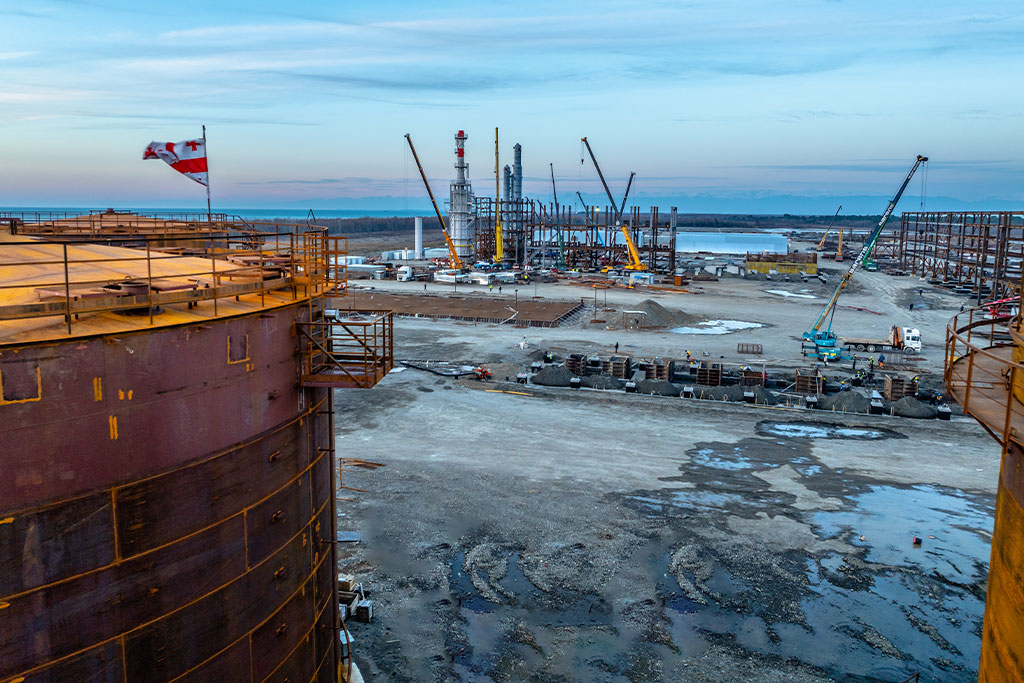
According to iFact, the company’s largest shareholder is Kakhi Zhordania, who held a 33% stake as of October 27. Zhordania is the son of Maka Asatiani, the owner of Black Sea Petroleum, which operates the newly launched Kulevi refinery on Georgia’s Black Sea coast. The refinery has recently drawn controversy after receiving a shipment of Russian oil. The cargo was supplied by the Russian oil company Russneft, which has since been sanctioned by the United Kingdom, while the tanker Kayseri that transported the oil was added to the EU sanctions list shortly after the reported delivery.
Georgian media outlets and watchdog groups have traced alleged links between Zhordania and his stepfather, Kote Gogelia, and Russian oil business circles, including Zhordania’s reported business ties with Sergei Alekseev, the son of Lieutenant General Vladimir Alekseev, the First Deputy Chief of Russia’s military intelligence service (GRU).
Also Read:
- 19/12/2025 – UK Calls on Georgia to Curb Russian Oil Imports Amid Wider Sanctions
- 05/12/2025 – TI-Georgia: Kulevi Oil Refinery May Raise Sanctions Evasion Suspicions in West