GD Adopts Laws Ending Voting for Georgians Abroad, Scrapping Anti-Corruption Bureau, ‘South Ossetia Administration’
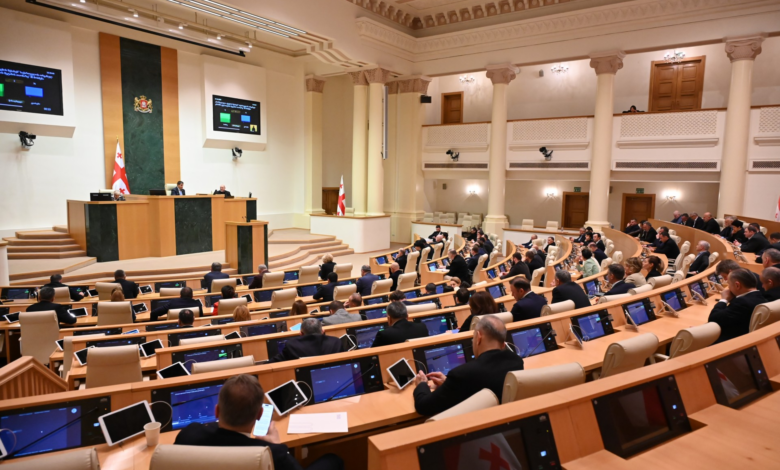
The disputed Georgian Dream-led parliament is wrapping up its fall session by rubber-stamping laws ending voting for Georgians abroad, dissolving the Anti-Corruption Bureau and the Personal Data Protection Service, and scrapping the so-called South Ossetia provisional administration, among others.
The laws adopted during the December 17 extraordinary plenary session also included dismantling the business ombudsman’s office, as well as controversial juvenile justice legislation allowing minors in conflict with the law to be placed in designated facilities.
The vote came on the second day of extraordinary plenary sessions taking place in the last week of the fall session of the disputed legislature. The session, which saw the passage of several controversial bills, including measures significantly curbing protest rights, will officially end with a bureau session on December 19.
Ending Voting Abroad
A new version of the election code, adopted with 79 votes in favor and 11 against, strips Georgian citizens of the right to vote abroad, allowing them to cast ballots only inside the country. The controversial change defines elections, referendums, and plebiscites as voting “taking place within Georgia’s state borders.”
Georgian Dream officials have defended the controversial change as necessary to “strengthen election resilience” against foreign interference. Critics, however, argue that it would disenfranchise Georgian émigré voters, attributing the move to the party’s poor performance in overseas constituencies, where it secured only 13% of the vote in the last parliamentary election.
More than a million Georgians are estimated to reside abroad, and individual Georgian households heavily depend on remittances. Yet only 34,574 were able to cast ballots in 2024, a gap critics attribute to the authorities’ unwillingness to ease hurdles for overseas voters.
Scrapping Data Protection Service, Anti-Corruption Bureau
Georgian Dream MPs also rubber-stamped a legislative package on December 17 abolishing two public agencies – the Personal Data Protection Service and the Anti-Corruption Bureau – which will both cease operations in March 2026.
The Anti-Corruption Bureau was created in 2022 as part of the European Commission’s fourth recommendation for Georgia to obtain EU candidate status. However, the agency was widely seen as having been instrumentalized by the ruling party to crack down on critics. Mandated to enforce repressive legislation, including two “foreign agents” laws and amendments to the Law on Grants, the Bureau, led by Razhden Kuprashvili, subjected dozens of NGOs, media organizations, and civic initiatives to inspections.
Following its abolition, the bureau’s functions will be absorbed by the State Audit Office.
Abolishing South Ossetia Provisional Administration
Georgian Dream also adopted in a final reading a package abolishing the so-called South Ossetia Provisional Administration, which was established in 2007 under then-President Mikheil Saakashvili. Announcing the move in November, the ruling party described the creation of the provisional unit in 2007 as “a grave betrayal of Georgia’s state interests” and one of the “contributing factors to the 2008 Russian military aggression.”
Specifically, parliament voted to declare null and void the laws “On Creating Proper Conditions for the Peaceful Resolution of the Conflict within the Former South Ossetian Autonomous District” and “On Property Restitution and Compensation for Those Affected by the Conflict in the Former South Ossetian Autonomous District on Georgian Territory.”
The provisional unit and its administration will be dissolved by January 1, 2026.
Juvenile Justice Legislation
Another package adopted during the December 17 extraordinary plenary session covers juvenile justice legislation introducing special procedures for children aged 10 to 18 who committed offenses before turning 14. It allows for placing them in designated “family-type” facilities called “House of Care and Support of Minors” for extendable periods of six months each and for a maximum of two years in total.
The facilities are intended to provide psycho-social support, as well as educational and vocational training to minors.
Authorities say the bill follows the “German model” and is intended to rehabilitate and support minors and prevent crime, but critics – including from the professional community of psychologists – have warned it risks stigmatizing children and will fail to deliver the resocialization it promises.
Also Read: