
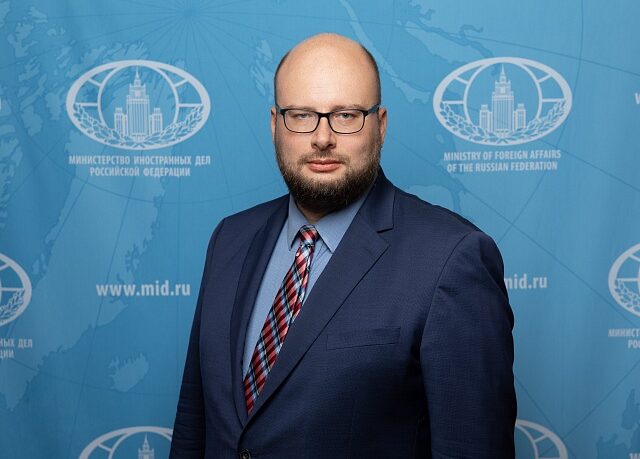
Russia is “seriously committed” to normalizing relations with Georgia, but “the main thing” is that Tbilisi does not become “a bargaining chip in anti-Russian games,” Mikhail Kalugin, director of the Fourth Department of CIS Countries at Russia’s Foreign Ministry, told RIA Novosti on December 16.
The remarks came as part of an interview where the official also said that Moscow seeks stable ties with Georgia and praised what he described as Tbilisi’s pragmatic, multi-vector foreign policy approach. He also spoke about Moscow’s interests in the broader South Caucasus region, reiterating Russia’s support for 3+3 regional format.
“We strive for stable relations with Georgia. Tbilisi demonstrates healthy pragmatism and a tendency towards a multi-vector approach to foreign affairs,” he said. “Georgia has not joined the anti-Russian sanctions coalition and rejected the externally imposed reckless scenario of opening a ‘second front’ against Russia.”
Kalugin claimed that Georgia’s stance had contributed to growing economic ties between the two countries, citing increased trade turnover and tourist flows, among others.
“If in 2022 the Georgian authorities, to please the Westerners, had chosen a line of confrontation with us, all this positivity would not have happened, and Georgia’s economy would not have grown by 40%,” Kalugin said.
Turning to Georgia’s relations with the European Union, Kalugin argued that the bloc had failed to meet Georgia’s economic expectations. He said that despite the Association Agreement and Deep and Comprehensive Free Trade Area signed in 2014, “no one is eager to see Georgian goods on the EU market.”
“Russia is seriously committed to normalizing relations with Georgia. The main thing is that Georgia not become a ‘bargaining chip’ in anti-Russian games,” he added.
Occupied Territories
Asked about the international status of Abkhazia and South Ossetia, Russia-occupied territories that Moscow recognized as independent states in 2008, Kalugin said their external ties go “beyond formal diplomatic recognition” and are developing dynamically.
Kalugin said Russian support includes helping expand international contacts of Sokhumi and Tskhinvali and encouraging recognition by additional states, as well as facilitating membership to international organizations, including those formed with Russian involvement.
“It can be said that the republics’ ‘international profile’ and global visibility are increasing. This is confirmed by the participation of foreign observers in monitoring the Abkhazian and South Ossetian elections,” Kalugin said, also citing the participation of Abkhaz and Ossetian athletes in the BRICS Games in June 2024. “In December 2025, Moscow hosted a session of the Parliamentary Assembly of the Union of Russia and Belarus, where the republics have observer status.”
Kalugin concluded by stressing the readiness of Sokhumi and Tskhinvali “to build a mutually respectful and equal dialogue with other countries, including Georgia.”
The official also said that Russia continues to work on moving Geneva International Discussions, international talks that emerged after the 2008 August war, to another location, but the decision “has not been made yet,” citing the need of “consensus” from all participants of the framework. Kalugin, however, expressed continued support for the framework, saying “it remains the only agreed platform for maintaining a constant direct dialogue between the official representatives of Georgia, Abkhazia, and South Ossetia on the issue of post-conflict restoration of relations between them.”
Tbilisi on Normalization: Recognize Territorial Integrity First
Georgian officials responded by restating Tbilisi’s long-standing position on normalization. Shalva Papuashvili, speaker of Georgia’s disputed parliament from the ruling Georgian Dream party, said during a press briefing that recognition of Georgia’s territorial integrity remains the key condition for restoring relations.
“We, of course, support the normalization, the precondition for this is the recognition of Georgia’s territorial integrity,” Papuashvili noted.
Kalugin’s remarks follow earlier statements from Russia’s Foreign Ministry. On December 3, the ministry told Russian newspaper Izvestia that Moscow is open to normalizing relations with Georgia but sees no prerequisites for resuming political dialogue as long as Tbilisi links diplomatic restoration to Russia withdrawing its recognition of Abkhazia and South Ossetia.
Also Read:
- 10/12/2025 – Tbilisi Distances Itself From Reports of Transit Hub Construction in Abkhazia
- 13/11/2025 – 65th Round of Geneva International Discussions
- 22/04/2025 – Abkhazia De Facto FM: Georgia Must Repeal Law on Occupied Territories
- 14/04/2025 – Moscow Ready to Restore Diplomatic Relations with Tbilisi, Galuzin Says
- 04/12/2024 – Zakharova: Russia Will Be Ready to Go as Far as Tbilisi is Ready To
This post is also available in: ქართული