
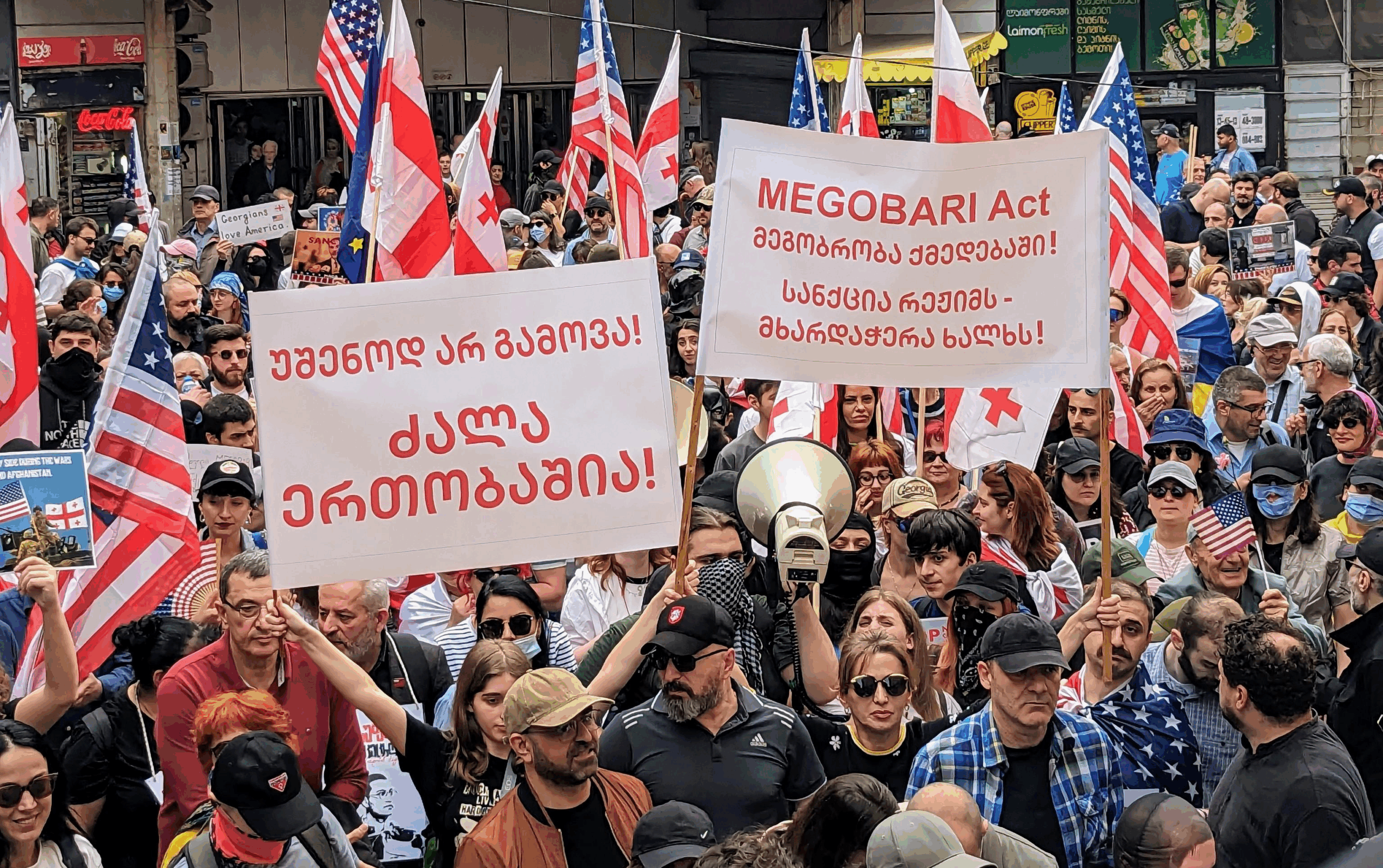
Many opponents of the ruling Georgian Dream party have pinned their hopes on the MEGOBARI Act, a bipartisan U.S. bill that proposes sanctions on Georgian officials responsible for the country’s anti-Western and anti-democratic turn. Optimism has dimmed recently, however, as reports came in from Washington, DC, that the bill, having passed the House of Representatives, has stalled in the Senate. As the fate of the MEGOBARI Act remains uncertain, much will depend on developments in Congress over the coming weeks, including whether the bill’s proponents will manage to attach it to so-called “must-pass” legislation.
Anna Kalandadze is an award-winning journalist based in Washington, DC. She has covered developments in Georgia, across Europe, and in the United States for over two decades.
Congressional leaders in the United States are working toward a swift conclusion for the Fiscal Year 2026 National Defense Authorization Act (NDAA).
That bill is currently in the Conference Committee process, where negotiators reconcile differences between the House and Senate versions. The expectation is to finalize the Conference Report – the unified, compromise bill – and hold final votes in both chambers as early as the first week of December. This high-stakes legislative push is designed to clear the “must-pass” defense bill for the President’s signature before the scheduled Congressional holiday adjournment, typically falling around December 19.
The inclusion of new provisions, such as the MEGOBARI Act, remains a critical, unresolved point that must be settled during these final negotiations.
What is the MEGOBARI Act?
The MEGOBARI Act (Mobilizing and Enhancing Georgia’s Options for Building Accountability, Resilience, and Independence Act) is a bipartisan legislative effort in the U.S. Congress aimed at supporting Georgia’s democratic and Euro-Atlantic aspirations while targeting government officials involved in corruption or anti-democratic actions. The English abbreviation of the bill MEGOBARI means “friend” in Georgian.
The MEGOBARI Act requires the U.S. President to impose sanctions on Georgian government officials and foreign persons determined to be:
- Undermining Georgia’s security or stability.
- Engaging in significant acts of corruption related to blocking Georgia’s Euro-Atlantic integration (joining NATO and the EU).
Sanctions mandated include visa bans and property-blocking sanctions (freezing assets). Immediate family members who have benefited from the sanctioned individual’s conduct are also subject to these measures.
Current Status: Passed House, Stalled in Senate
The Act passed the U.S. House of Representatives on May 5, 2025, with strong, bipartisan support – 349 votes in favor.
Key House sponsors included:
- Rep. Joe Wilson, a Republican, lead sponsor and a co-chairman of the U.S. Helsinki Commission;
- Rep. Steve Cohen, a Democrat, co-sponsor;
- Rep. Richard Hudson, Republican, and
- Rep. Marc Veasey, a Democrat.
Key Senate sponsors include:
- Sen. Jeanne Shaheen, a Democrat and Lead Sponsor
- Sen. Jim Risch, a Republican, Co-Sponsor
The Roadblock: In August 2025, an attempt to include the MEGOBARI Act’s text in the annual National Defense Authorization Act (NDAA) was reportedly blocked by certain Senators, most notably Republican Markwayne Mullin.
What’s Next: The ‘Christmas Tree’ Bill?
The bill is currently stuck in the Senate and risks dying if the Senate does not act before the 119th Congress concludes at the end of 2026. The most likely path forward is a high-stakes legislative maneuver in December 2025.
The traditional way to circumvent the Senate blockage is to seek a Senate Floor Vote, which means a full Senate debate. The outcome of the vote is uncertain due to reported opposition from certain Senators.
An alternative maneuver is the Conference Committee Strategy, which means that the proponents will attempt to include the MEGOBARI Act in the final text of the NDAA Conference Report, trying to ensure its passage by attaching it to a “must-pass” legislation.
The NDAA is an annual bill that authorizes the U.S. Department of Defense budget and sets national security policy. It is considered “must-pass” legislation and has been successfully enacted every year for over six decades. This near-certainty of passage makes it a powerful vehicle.
Because its passage is virtually assured, the NDAA is often referred to as a “Christmas tree.” By attaching the MEGOBARI Act during the final Conference Committee negotiation, proponents can bypass procedural holds that stall standalone bills in the Senate. If the Act is added here, Senators must vote for or against the entire defense bill, making opposition to a single component very difficult.
Also Read:
- 30/09/2025 – Op-Ed | No Benefit, No Spotlight: Trump Administration’s Georgia Policy
- 19/09/2025 – U.S. House Committee Approves GD Non-Recognition Amendment for Inclusion in State Dep. Bill
- 11/09/2025 – U.S. Helsinki Commission Holds Hearing on Georgia’s “Anti-American Turn”
- 14/05/2025 – GD Parliament: MEGOBARI Act “Extremely Hostile” and “Factually Flawed”