
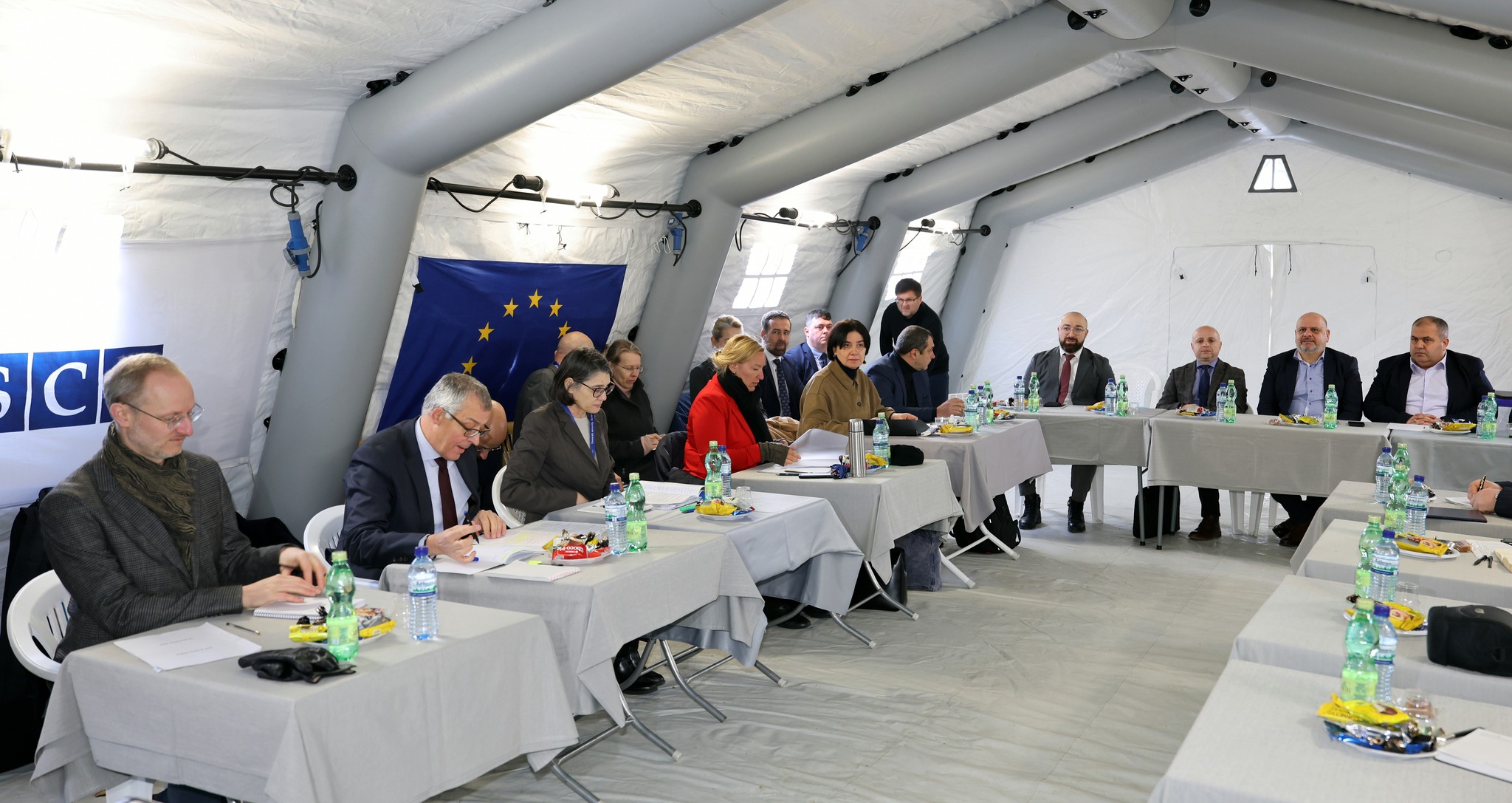
The 129th meeting of the Incident Prevention and Response Mechanism (IPRM) was held on December 22 in the village of Ergneti, near the occupation line with Georgia’s Russia-occupied Tskhinvali region.
The meeting was co-facilitated by Bettina Patricia Boughani, Head of the EU Monitoring Mission in Georgia (EUMM), and Christoph Späti, Special Representative of the OSCE Chairperson-in-Office for the South Caucasus.
SSSG’s Statement
The State Security Service of Georgia (SSSG) stated that “all important incidents” along the occupation line that occurred since the previous IPRM meeting were discussed.
As in previous meetings, “representatives of the State Security Service once again demanded the punishment of those responsible for the killing of Georgian citizen Tamaz Ginturi.”
The SSSG said its representatives also “placed particular emphasis” on the issue of persons held in illegal detention, demanding their immediate release. According to the agency, the discussions also focused on the illegal restriction of freedom of movement and cases of so-called borderization.
Ahead of the meeting, Irakli Antadze, deputy head of the State Security Service of Georgia’s analytical department, told reporters that during the reporting period, 11 people have been detained and two cases of so-called borderization were recorded. He said the incidents occurred near the village of Kvemo Khviti in Gori Municipality and the occupied village of Artsevi.
EUMM, OSCE Statements
Participants at the final IPRM meeting of 2025 reaffirmed their commitment to continuing the format, stressing its importance for security and humanitarian issues along Georgia’s dividing lines, according to co-facilitators of the talks.
“Participants discussed all recent security developments and challenges faced by conflict-affected communities, including restrictions on freedom of movement and safeguarding energy infrastructure and supply,” the press release said. “Discussions also touched upon the resolution of cases of lost livestock through rapid exchange of information by using the hotline.”
The co-facilitators reiterated concern over “the continued practice of detentions,” saying it “negatively impacted perceptions of the security of local population.” They called for “a prompt resolution of the detention cases, including through a humanitarian approach,” and emphasized that “increased movement across the Administrative Boundary Line would help build trust and enhance the sense of security among local communities.”
In this context, the co-facilitators advocated extending the December opening of controlled crossing points into January, saying it would “facilitate increased movement during the holiday season.” Such an extension, they said, would allow families separated by the ABL to reunite, take part in religious celebrations and maintain “essential social connections during this time traditionally devoted to family gatherings.”
Participants also commended “the excellent operation of the EUMM-managed Hotline,” describing it as an effective tool for sharing “reliable and timely information on security and humanitarian matters.”
De Facto Authorities’ Statement
Igor Kochiev, the de facto representative of the Russian-occupied Tskhinvali region, briefed reporters after the meeting, saying that IPRM meetings remain an effective platform for maintaining a stable and predictable situation.
“Within the IPRM, we promptly resolve issues that arise on the ground, working directly with the population and Georgian counterparts,” Kochiev said. “Urgent and sensitive issues are raised promptly, and concrete decisions are made on them, which helps maintain a calm and more predictable situation.”
Kochiev also claimed that since the previous meeting, one alleged violation by a Georgian citizen had been recorded. He also told journalists that the EUMM reported two violations, saying one may have occurred due to insufficient situational awareness, possibly linked to the rotation of observers.
The next IPRM meeting is scheduled to take place on February 4, 2026.
The Incident Prevention and Response Mechanism (IPRM) was established in 2009 within the framework of the Geneva International Discussions that followed the 2008 Russo-Georgian war. It serves as a forum for the regular discussion of security-related incidents and developments on the ground. IPRM meetings have been held regularly in Ergneti, near the Tskhinvali occupation line, with the participation of representatives from Tbilisi and the Tskhinvali de facto authorities. In contrast, meetings in Gali, in occupied Abkhazia, have been suspended multiple times, from 2012 to 2016, and again since 2018. The meetings are co-facilitated by the OSCE and the European Union Monitoring Mission in Georgia (EUMM).
Also Read:
- 17/12/2025 – GD Adopts Laws Ending Voting for Georgians Abroad, Scrapping Anti-Corruption Bureau, ‘South Ossetia Administration’
- 19/11/2025 – 128th Ergneti IPRM Meeting
- 13/11/2025 – 65th Round of Geneva International Discussions
- 12/11/2025 – Ex-PM Gakharia Charged in Absentia Over ‘Gavrilov’s Night,’ Chorchana Tensions
This post is also available in: ქართული