
“Georgian Dream – the first government in Georgia’s history to make higher education free!” reads a card published on the ruling party’s Facebook page on December 5, featuring Bidzina Ivanishvili, the party’s billionaire founder and honorary chairman.
For days, the ruling party has been promoting the government’s plan to dramatically overhaul the universities’ funding model. Under the currently effective voucher-based system, public funds follow individual students, financing their studies at the higher education institution of their choice, whether public or private. Introduced in the early 2000s, the model allocates state grants to each student based on their performance in the Unified National Exams.
But starting from the 2026 admissions cycle, the state will fully cover tuition for all students who enrol at public universities. Under the new model, public universities will receive direct state financing based on their needs, while private universities are about to lose the public funding that students brought with them.
The government says this will improve access to higher education. Critics warn that the opposite may happen. “If you can’t get into [public university], you will have to go and study at a private university, where the cost will further increase,” Nino Doborjginidze, a Rector of Tbilisi’s Ilia State University, told TV Pirveli, doubting that the reform can meet the announced objective. There is concern that public universities will enroll fewer students, while the withdrawal of public funding would only drive up the cost of studying at private institutions.
Another concern is that relying on direct state funding could compromise the autonomy of public universities, which make up 19 of the country’s 64 accredited higher education institutions.
GD Promises Radical Overhaul
Plans to abolish the vouchers model are only one part of a broader – and contentious – higher education concept that Georgian Dream Prime Minister Irakli Kobakhidze unveiled in mid-October and vigorously defended since.
The reform concept, approved by the government in early December with minor revisions, proposes, among other changes, the “deconcentration” of higher education from Tbilisi, the creation of a new university hub in Kutaisi in western Georgia, and the principle of “one city, one faculty.” This means that a single faculty – such as law or social sciences – can only be offered by one public university in each city.
It also introduces a 3+1+1 bachelor’s and master’s model in place of the current 4+2 system. Under the change, most BA programs would be reduced from four to three years, while professional master’s programs would last one year, with the option for students pursuing further academic study to apply to a two-year master’s program. Another major change is that, starting next academic year, public universities will generally be barred from admitting foreign students.
The reform concept comes as part of Georgian Dream’s broader effort to reshape the entire education system, including a newly announced public school reform that would introduce, among other changes, a shift to an 11-year model in which the 12th grade becomes optional. Education officials hope that the reduced study periods would bring more youths to the job market more quickly.
Ideological drive against “Liberal Fascism”
The higher education concept seeks to fix “what was done wrong in the 90s and then in 2004–2012,” Kobakhidze said during a government meeting on December 1, echoing long-standing party rhetoric that accuses the previous United National Movement (UNM) government of deliberately undermining the education system, including through efforts to “breed a new Georgian.”
“An insufficiently educated public is easily subjected to manipulation, external interference; it is easy to sow hate in such a society; it is easy to spread ideologies such as were once Bolshevism, fascism, and such is today’s contemporary liberal fascism,” the GD prime minister said. Kobakhidze has been pursuing a parallel academic career, teaching constitutional law at Tbilisi State University.
He and other officials have defended the reform as a response to persistent challenges of quality and infrastructure, as well as a need to ensure more balanced development across the country, noting that 85% of all university students are currently concentrated in Tbilisi.
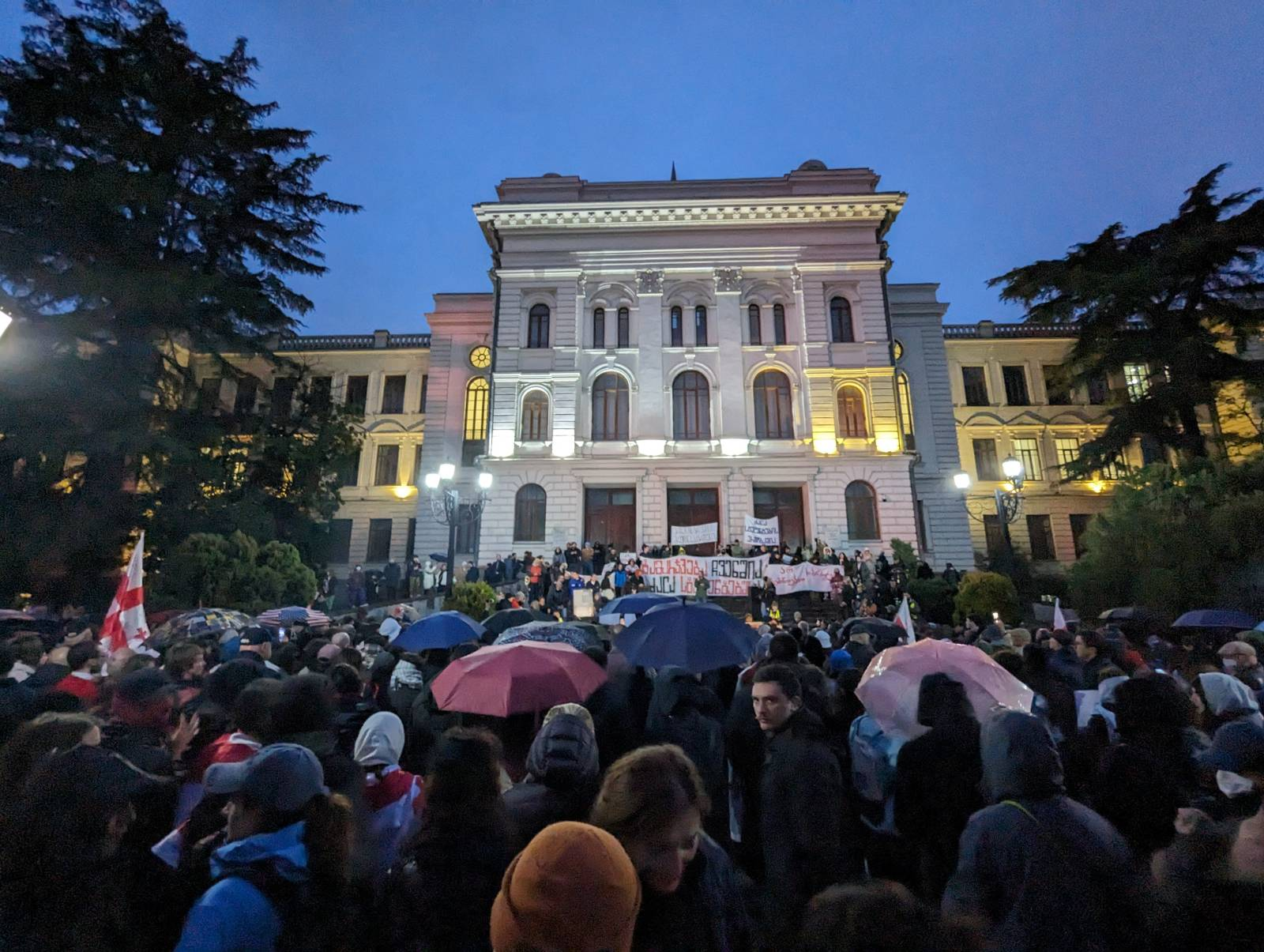
But the reforms come amid growing attacks on universities by the ruling party and its media, accusing them of lingering UNM influence and of mobilizing students with foreign support to plot against the Georgian Dream government. The attacks, coinciding with an ongoing crackdown on media, civil society, and civil servants critical of the ruling party, have led many to fear that repression would at some point extend to academia. When the reform was finally unveiled in October, part of the academic community saw it as confirmation of their concerns.
27/11/2025 – Dozens Reportedly Fired From National Exams Center in ‘Reorganization’
Reform or ‘Deform’?
Critics have described the reform as “deeply problematic” or even “catastrophic,” warning that it could undermine academic independence, trigger purges within universities, and limit Georgian students’ access to education. Some have even labeled the reform a “deform,” arguing that the policies risk dismantling over a century of Georgian university tradition and setting the education system back by decades.
Proposed solutions “are marked by centralisation, political control, and a worrying return to discredited approaches,” Maia Chankseliani, Georgian education expert and Oxford University professor, warned in October. “If implemented, they risk undoing much of the progress made by Georgian higher education institutions over the past two decades.”
There are fears that the radical restructuring of public universities, which allows the state to strictly define and limit the programs each institution can offer, not only undermines autonomy but also risks chaos. Academics anticipate a sharp decline in the number of professors, fearing the process may be used to remove those critical of the ruling party from state universities. The push for geographic deconcentration may also introduce additional infrastructural challenges. Officials said that some state university buildings in Tbilisi could be sold.
“It looks more like gutting the universities than a reform,” Doborjginidze said on November 6, following a rectors’ meeting with Education Ministry officials. Ilia State University, which Doborjginidze leads, has frequently been targeted by ruling party propaganda amid anti-government protests. The university has been among Tbilisi’s flagship higher education institutions, offering students a wide range of programs, from arts and humanities, law, and social sciences to business, natural sciences, and medicine.
“If state regulations restrict universities from offering certain programs or admitting international students in certain departments, how would this not constitute a limitation on academic freedom and institutional autonomy?’ Donborjginidze asks.
Focus on market demands
Georgian officials have sought to allay fears of professor purges by arguing that the reform would require more, rather than fewer, personnel. Authorities have also promised improved conditions for academics, including a greater focus on full-time positions and salary increases.
However, as much uncertainty remains, so do the fears. Authorities have yet to provide detailed plans, including how the specific programs will be assigned to universities and how many students each program will admit. Citing a “radical mismatch” between labor market demands and the trained workforce, officials say these decisions will be based on ongoing market research conducted by the authorities in collaboration with the business sector.
“The [student] quotas will be distributed according to specialties precisely based on the labor market analysis,” Kobakhidze told journalists on December 6. “As for the total numbers for students to be admitted, the number will stay essentially the same.”
But those in academia think the government’s approach completely misinterprets the role students and universities are expected to play.
A student “is seen as a cog who must fulfill a certain role in the country’s economy,” Ketevan Chachkhiani, a scholar and education researcher at Arizona State University, said during a discussion about the announced reform organized early in December by Ilia State University. “As a rule, it should be that the independence and the freedom a university receives must enable a student to be free,” Chachkhiani noted.
Also Read:
- 17/10/2025 – Georgian Technical University Rector Seeks Seizure of University of Georgia Property
- 10/03/2025 – University Suspends Protesting Students, Watchdog Speaks Out About GD’s Suppression of Student Protest
- 20/11/2024 – TSU Allegedly Allowed Police to Use its Grounds for Crackdown, Sparking Outrage
- 4/12/2023 – Georgian Dream’s Conservative Drift Now Targets Schools