Georgian Dream Proposes General Education Reform Anchored in Identity, Uniformity
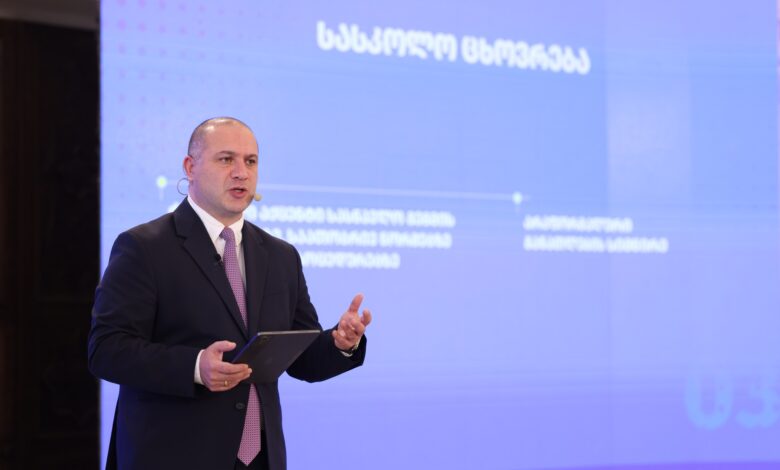
Georgian Dream Education Minister Givi Mikadze, on December 2, unveiled a general education system reform concept that, among other initiatives, would introduce state-approved single textbooks across all public schools, make uniforms mandatory for grades 1–6, ban mobile phones during class hours, and restructure the system around an 11-year schooling model, with the 12th grade becoming optional.
The presentation of the school reform concept came almost two months after Georgian Dream Prime Minister Irakli Kobakhidze introduced a higher education concept, and a day after it was approved. The proposals raised concerns about academic freedom and the possibility of repression in universities.
“If a student does not acquire at their school desk the knowledge and skills that will later be needed in their professional life, the system as a whole cannot be successful,” Georgian Dream Prime Minister Irakli Kobakhidze said in his opening remarks at the event, which was also attended by GD cabinet members and lawmakers from the disputed Parliament. “That is why we have paid particular attention to general education reform,” he added, before giving the floor to GD Education Minister Givi Mikanadze, who presented the document.
Challenges and Objectives
“Today, the general education system faces many complex challenges,” Mikanadze said, noting that the current system “fails to ensure the full development of young people with a sense of state responsibility, adequate competitiveness and clear interests,” blaming, among others, a 2004-adopted document on National Goals of General Education he described as “entirely filled with liberal values.”
Speaking about the renewed strategy presented by the Georgian Dream government in late 2023 and adopted by Parliament in 2024, Mikanadze said it is now based on “national values” and a “patriotic spirit.”
Mikanadze then outlined the key components of the new National Goals of General Education, including the preservation and transfer of national identity and cultural self-awareness; deep knowledge of and respect for the state language, culture and history; respect for cultural diversity; raising a person with state and civic consciousness; raising critically thinking, creative citizens; promotion of students’ personal and social development; and establishing healthy lifestyles and well-being among students.
Mikanadze then identified eight key challenges facing the current school system, including educational program content, learning resources, limited informal education, weak links between educational levels, teacher qualifications, a safe learning environment, inclusiveness of the process, and school management and funding.
According to Mikanadze, the initiatives have been prepared to address the eight challenges.
Changes towards uniformity
Under the first set of changes, Mikanadze said that teaching of what he described as “fundamental subjects,” such as Georgian language, history, and geography, will be strengthened. School levels will be defined as primary (grades 1–6), lower secondary (grades 7–9), and upper secondary (grades 10–11).
Dismissing what he called “speculative statements” about shifting to an 11-year schooling model from the current mandatory 12 years, Mikanadze said 11 years “will be sufficient for providing our youth with a high-quality general education.” He said the 12th grade would remain optional, with students able to register each March to enroll, after which classes would be opened for the following academic year.
Mikanadze said the 11th grade will become a profile-based, exam-focused year with the introduction of a “repetitorium,” which he said would ease families’ financial burden by preparing students for national university entrance exams within the school system, eliminating the need for private tutoring.
Under the second set of changes, Mikanadze said that over the next two to three years, all existing textbooks, which currently can differ from school to school, will be replaced with new, single textbooks written by “expert groups,” which he said had already been selected over the past six months. The guiding principle, he said, will be “one textbook in every school for each discipline.”
“There will no longer be different textbooks. There will be a unified approach in all schools – a unified standard and unified quality – giving us the opportunity for unified recognition, consistent quality assurance, equal access to the process and, most importantly, measurable outcomes.”
The third change, Mikanadze said, seeks to strengthen informal education in schools. Praising what he described as a “value-based education” project launched this year with Georgia’s Patriarchate, he said the program is currently implemented in more than 50 schools, “where children are taught love for their homeland, life values and friendship,” adding that the Education Ministry plans to expand it further.
Under the next set of changes, Mikanadze said that starting next year, only children who turn six by September 15 will be eligible to enroll in school, tightening the current rule that allows enrollment for those turning six by December 31. He cited learning difficulties among children who begin school at a younger age. He added that the Education Ministry plans to introduce a preliminary registration phase prioritizing school placement based on residential areas, initially in major cities, and said schools will also establish career and professional centers.
The fifth change focuses on teachers’ career development. “Pedagogy will be transformed into a field of the highest academic level,” Mikanadze said, adding that a new teacher career advancement scheme is set to be approved in January 2026. The reform, he said, will allow teachers “to realize their potential not only locally, at the school level, but also at the district, municipal and national levels.”
As part of the next set of changes focused on the learning environment, Mikanadze said, among others, “It is important for us to ensure students’ focus and full engagement in the educational process,” for which, he said, “the use of mobile phones will be banned during school hours.” He noted that specific rules are yet to be drafted, but pledged that the learning process would not be disrupted and that students’ ability to communicate with parents would be preserved.
To promote inclusiveness, Mikanadze said one step will be the introduction of mandatory school uniforms in public schools for grades 1–6, beginning next academic year as a pilot phase.
Regarding management and funding, Mikanadze said ministry representatives will proactively meet with parents to identify challenges, and that the ministry will consider developing new models for school financing.
“Taking these steps will fundamentally change the teaching and learning process, making it more effective and results-oriented,” Mikanadze said. The result, he added, is “the progress of our country, the future of our society, its strengthening and development, and raising our children in the national spirit that has always traditionally characterized our country.”
Also Read:
- 10/03/2025 – University Suspends Protesting Students, Watchdog Speaks Out About GD’s Suppression of Student Protest
- 20/11/2024 – TSU Allegedly Allowed Police to Use its Grounds for Crackdown, Sparking Outrage
- 29/10/2021 – Former School Principal Speaks of Dismissal on Political Grounds
- 20/09/2021 – “The Students Are Hungry”: the Lack of Adequate Food Provision in Schools as Great Unaddressed Question of Georgia’s Educational Reforms